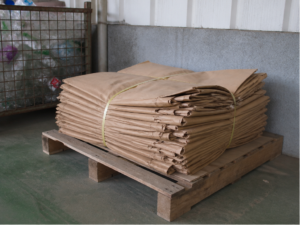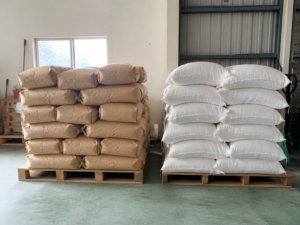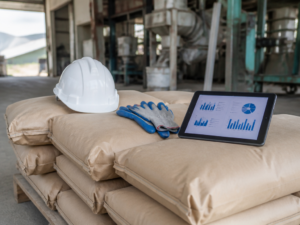
When many people hear kraft paper bag, they picture a coffee shop takeout bag or an envelope for mailing documents. But in our factory at Chiahuang Paper, a kraft paper bag means something else entirely: a heavy-duty industrial packaging bag that can hold 25 kg of cement or 40 kg of powder, and withstand high-speed filling, pallet stacking, and long-distance transport. Both types are made from kraft paper, but they're completely different tiers of product. Choosing the wrong one can mean wasted money at best, or burst bags, moisture damage, and a scrapped shipment at worst.
Chiahuang was founded in 1973 in Shanhua, Tainan, and for more than fifty years we've focused on industrial paper bags. In this article, I want to explain—from a factory floor perspective—what an industrial kraft paper bag actually is, how it differs from a standard kraft paper bag, and the key points you really need to confirm before requesting a quote, so you can nail down the specs from the start.

What are kraft paper bags? Understanding three main applications
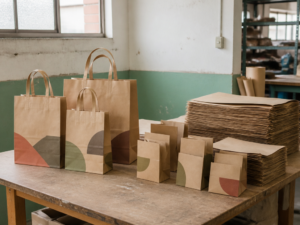
Kraft paper is made from wood pulp or recycled fibers, with coarse, tough fibers that give it a brownish-yellow color and strong tensile and tear resistance—which is why it's so widely used in packaging. But the term "kraft paper bag" actually covers three quite different products in the market. The first is the retail tote bag, where appearance and print quality matter most. The second is the envelope or mailing bag, where size and mailing convenience are key. The third—and the focus of this article—is the industrial heavy-duty kraft paper bag, where load capacity, moisture protection, and compatibility with the customer's filling line are what really count.
| Bag Type | Common scenarios | Load capacity requirements | Structural features | Procurement priorities |
|---|---|---|---|---|
| Retail carry bags | Food delivery, apparel and gift packaging | Within a few kilograms | Single or double-layer paper with handles | Appearance, print quality, unit cost |
| Envelopes and document bags | Document storage and mailing | Lightweight primarily | Single-layer paper, open-end or with closure | Size, paper thickness |
| Industrial heavy-duty kraft paper bags | Cement, chemical powders, animal feed, fertilizer, sugar, etc. | Primarily 25 kg and 40 kg capacities | 1–5 layers of long-fiber kraft paper, optional lamination, microperforated venting, anti-slip coating | Load capacity, moisture resistance, filling compatibility |
International standards make the same distinction. ISO 6590-1:2025 "Packaging — Vocabulary — Part 1: Paper sacks" defines the terminology commonly used in manufacturing paper sacks, covering single-ply and multi-ply paper-based sacks, while explicitly excluding retail bags (see the official ISO page). In other words, even by standard definitions, industrial paper bags and retail tote bags are not the same category—and that's the lens we use when discussing specifications too.
Why are industrial kraft paper bags made with multiple layers
A common misconception among non-experts is that bag durability simply comes down to paper thickness. In reality, two factors determine load-bearing performance: what paper is used, and how it's layered. Chiahuang's heavy-duty bags are built on long-fiber kraft paper, which offers better load-bearing capacity and tear resistance. The paper is then layered from 1 to 5 plies, so external force is distributed across each layer rather than concentrated on a single sheet. Multi-ply construction has another advantage: it can be combined with an optional PE/PP lamination layer to form multiple moisture barriers. For a full illustration of the layered structure, see our overview of multi-ply paper structures.

There's no one-size-fits-all number of plies, and this is a point I want to emphasize. The most common packaging sizes in the market are 25 kg and 40 kg. For plain kraft paper, 25 kg bags are typically made with 3 plies and 40 kg bags with 4 plies. If a three-ply kraft composite material is used instead, 2 plies are often enough to meet most requirements, since the material itself is stronger. These are starting points, not fixed conclusions—the actual number of plies still depends on the characteristics of the contents, the filling method, and the transport and stacking conditions.
| Package Weight | Paper material type | Common layer counts | Description |
|---|---|---|---|
| 25 kg | Kraft paper only | Typically 3 layers | Most common heavy-duty specification in the market |
| 40 kg | Kraft paper only | Typically 4 layers | Heavy-load specification with higher tear resistance and stacking requirements |
| 25–40 kg | Three-in-one kraft composite material | Typically 2 layers | Better material strength; 2 layers sufficient for most applications |
| Other weights or special environments | Adjust per design | 1–5 layers | Ocean export or hygroscopic contents may require additional layers or lamination coating |
Our approach is not to "add a few extra plies just to be safe" for customers. Every additional ply adds cost, but doesn't necessarily improve the result. Matching paper quality with the right structural design matters far more than blindly adding plies. That's why we always ask about the actual use case before quoting a price.
Four field challenges solved by one kraft paper bag
The real challenges with heavy-duty bags usually aren't about capacity—they show up on-site. During high-speed filling, trapped air that can't escape fast enough can cause the bag to burst. On pallets, a slippery bag surface can lead to collapse during a single transfer. In humid warehouse conditions during the rainy season, contents can clump together. And under heavy impact from a drop, seams can split. We have a specific treatment for each of these four issues, summarized in the table below.

| On-Site Issue | Corresponding solutions | Function |
|---|---|---|
| Moisture absorption, caking | Lamination (PE/PP), multi-layer structure | Forms a physical water-resistant barrier, blocking moisture penetration |
| High-speed filling rupture, dust generation | Micro-Pore Venting | Allows air inside the bag to escape immediately, preventing powder leakage |
| Pallet stack collapse | Anti-Slip Agent | Increases friction between bags |
| Heavy-load drop with torn seals | Stitching and heat-seal OverTape | High sewing strength; OverTape provides excellent sealing |
The most common way to add moisture protection is lamination—coating the paper surface with a layer of PE or PP film to create a waterproof barrier. Lamination itself is a single-layer treatment, separate from the bag's 1-to-5-ply structure, so the two shouldn't be confused; see our explanation of lamination processing for details. Micro-perforation venting involves adding tiny holes in the bag to let air escape during filling without letting powder leak out—this is especially important for automated filling lines. Anti-slip treatment is applied to the bag surface to increase friction and reduce the risk of pallet collapse. For sealing, we offer two options: sewn closures and heat-sealed OverTape. Sewn seams offer high strength, ideal for heavy loads and drop impact; heat-sealed OverTape provides better sealing, suited for applications with strict dust-leakage requirements. The two methods can also be combined.
Three questions we ask before selecting kraft paper bags
When customers come to us for a quote, the best outcome is when they clearly explain the use case from the start. We typically confirm three things first: the contents—weight, whether it's powder or granules, and moisture sensitivity; the filling method—manual, semi-automatic, or high-speed automatic filling, which determines whether micro-perforation venting is needed and how the bag shape should be designed; and the storage and transport environment—whether it's stored outdoors, whether it will go through a humid season, how many layers will be stacked on a pallet, and whether it's for overseas export. The answers to these three questions essentially determine the number of plies, whether lamination is needed, and whether anti-slip treatment should be added.
Even for the same 25 kg bag, the design priorities differ depending on whether it holds cement, chemical powder, or animal feed: cement calls for moisture resistance and anti-slip properties, chemical powder calls for venting and leak prevention, and feed often adds brand printing and moisture barrier requirements on top. These differences can't be captured in a simple spec sheet, which is why we'd rather ask a few more questions than quote a price based on dimensions alone.
Printing, plate costs and minimum order quantities: Budgeting tips
Industrial heavy-duty bags can be printed in up to four colors, with brand logos, specification information, and warning symbols all printable on the bag surface. One thing worth noting: print color affects pricing. The number of print colors, print area, number of plates, and production quantity all influence plate-making and printing costs—generally, more colors mean higher cost. If budget is a concern, we can recommend a suitable printing configuration based on your branding needs and budget, balancing visual impact with cost.
New designs require plate-making, and there's one condition worth clarifying upfront regarding plate fees: only once cumulative orders within a year reach 50,000 units can the plate fee be deducted from the order amount. The minimum order quantity for customized production is around 5,000 units. This is also why we recommend that customers confirm specifications based on actual filling and stacking conditions before placing a formal order.
Kraft paper bags and sustainability: FSC materials and recycling separation
Kraft paper is made from fiber, which is one reason many brands choose paper bags. Chiahuang holds FSC sustainable sourcing certification. If your procurement specifications require sustainably sourced kraft paper, you can specify FSC-certified material when requesting a quote, and we'll provide certification documents for audit purposes. On the quality management side, we are also ISO 9001 certified.
Another point worth considering in advance is what happens to the bag after use. According to the New Taipei City Resource Recycling Information Network, general paper recycling is divided into four categories: white paper, mixed paper, newspaper, and kraft paper. Paper containers with a plastic lamination surface must be recycled separately from general paper, as they require a completely different processing method (see the New Taipei City Resource Recycling Information Network). This is a reminder that lamination makes a paper bag more moisture-resistant, but it also changes how the paper material is recycled. Whether to use lamination should be weighed against both moisture-protection needs and end-of-life handling—not applied as a default to every bag type.
Frequently asked questions about kraft paper bags
What is the biggest difference between industrial kraft paper bags and regular kraft paper bags?
The biggest difference lies in load capacity and structural design. Standard tote or envelope bags are mostly single- or double-ply, with the focus on appearance and size. Industrial kraft paper bags, by contrast, use long-fiber kraft paper built into 1-to-5-ply structures designed to bear 25 kg or 40 kg loads, while also accommodating filling line requirements, moisture protection, and stacking needs—with optional treatments like lamination, micro-perforation venting, and anti-slip coating.
How many layers should a 25 kg kraft paper bag have?
There's no fixed answer. Based on common market practice, plain kraft paper 25 kg packaging typically uses 3 plies, and 40 kg typically uses 4 plies, while three-ply kraft composite material usually requires only 2 plies to meet most needs. The actual choice still depends on the characteristics of the contents, the filling method, and transport and stacking conditions. Let us know your use case when requesting a quote, and we'll recommend a suitable structure.
Are kraft paper bags susceptible to moisture? How to protect against moisture?
Untreated kraft paper absorbs moisture, so moisture-sensitive contents or humid storage environments require extra protection. A common solution is to add an optional PE or PP lamination layer within the multi-ply structure to form a waterproof barrier, with additional plies added if necessary. The choice and thickness of lamination are adjusted based on storage conditions and the moisture sensitivity of the contents.
Can kraft paper bags be printed with company logos? Does print color affect pricing?
Yes, Chiahuang offers four-color printing. Print color affects pricing, since the number of print colors, print area, number of plates, and production quantity all influence plate-making and printing costs—generally, more colors mean higher cost. We can recommend a suitable printing configuration based on your budget and product requirements.
What information should I prepare when requesting a quote?
We recommend preparing information on the contents and weight per bag, the filling method and equipment, the storage and transport environment, and whether printing is needed. The more complete the information, the more accurately we can recommend specifications in one go—typically with a response within one business day.
Conclusion: Choosing the right kraft paper bag starts with clarifying your usage scenario
A kraft paper bag may look like a simple product, but behind every industrial version is a complete design involving paper material, ply count, lamination, venting, anti-slip treatment, and sealing. Having worked in this field since 1973, our deepest takeaway is this: the spec sheet is only a starting point. What truly keeps a bag from failing in the field is understanding the contents, filling process, and storage/transport conditions upfront. If you're evaluating a new heavy-duty packaging solution, feel free to check out the specifications for our heavy-duty industrial paper bags, then visit our Contact Us page to tell us about your contents, weight, filling method, and usage environment. Chiahuang will respond within one business day with spec recommendations and pricing guidance.