A cement bag may look like just a paper sack filled with grey powder, but on the factory floor it has to withstand damp warehouses, stacking loads of several tons, the pressure impact of high-speed filling machines, and bumpy transport the whole way. At Chia Huang Paper, we've been making industrial paper bags since 1973, and this article explains how to choose cement bags from a manufacturing standpoint: how to determine ply counts for 25kg and 40kg bags, whether to add lamination and micro-perforation, and how to pair anti-slip coating with seam sealing.
Let's start with the conclusion: there's no one-size-fits-all answer for cement bags. Even at the same 40kg weight, outdoor transshipment and direct indoor delivery have different requirements; even at the same 25kg weight, automatic filling lines and manual filling need different bag designs. That's why we always ask about the actual use case before quoting, so we can determine the right structure.
What site conditions must cement bags withstand?
We don't approach cement bags from a spec sheet—we work backward from what can go wrong on site. Cement is a powder that clumps once it absorbs moisture, so if a warehouse gets damp, the bag must keep moisture out while also holding up under the weight of stacking. During filling, air inside the bag gets pushed in at high speed by the powder and needs somewhere to escape. And once pallets are stacked several layers high, a bag surface that's too slippery can cause the whole stack to collapse during a single transfer. The table below brings these conditions together with their corresponding design solutions.
| Site Conditions | Potential Issues | Corresponding Bag Design |
|---|---|---|
| Damp storage | Bags absorb moisture and soften; cement hardens | PE/PP coating; multi-layer structure |
| Single bag 25–40 kg | Bags tear or rupture under heavy load | Long-fiber kraft paper; number of layers designed based on weight |
| High-speed automatic filling | Rapid internal pressure buildup bursts bag bottom | Micro-Pore Venting |
| Multi-layer pallet stacking | Insufficient surface friction causes shifting and collapse | Anti-Slip Agent |
| Heavy drop impact | Bag bottom or seal splits open | Stitching and heat-seal OverTape |
How many layers for 25 kg and 40 kg cement bags?
The most common cement bag specifications on the market are 25kg and 40kg. Chia Huang's paper bags are structured with 1 to 5 plies, using long-fiber kraft paper, which offers better load-bearing capacity and tear resistance. In common practice, 25kg bags made of plain kraft paper typically use 3 plies, while 40kg bags typically use 4 plies; if a three-in-one composite kraft paper is used instead, because the material itself is stronger, 2 plies are usually enough to meet most requirements.
| Package Weight | Kraft paper only | Three-in-one kraft composite material | When reinforcement is needed |
|---|---|---|---|
| 25 kg | Typically 3 layers | Typically 2 layers | Adjust layer count or combine with coating based on storage and transport conditions |
| 40 kg | Typically 4 layers | Typically 2 layers | For heavy load and high stacking, reinforce tear resistance and seal design |
| Overseas export, highly moisture-absorbing environment | Increase layer count | Adjust per design | Can combine with coating to create moisture barrier |
This table is a starting point, not a conclusion. Adding an extra ply adds extra cost, but it doesn't necessarily lead to a better result, so we don't simply add plies for extra assurance. What really determines ply count comes down to three factors: bag weight, material structure, and the actual conditions of filling, transport, and stacking. Reinforced plies or lamination are only considered for long-distance export, extra-heavy loads, or contents that are especially moisture-sensitive.
Moisture protection, ventilation, and anti-slip: how to combine three finishing options
For moisture protection, Chia Huang offers PE lamination, PP lamination, and woven fabric lamination. Lamination involves coating the surface of the bag material with a plastic film to form a physical waterproof barrier, so even if the warehouse experiences brief dampness, the bag structure is less likely to soften from moisture penetration. The choice of film type and thickness is adjusted based on warehouse conditions and how moisture-sensitive the contents are—thicker isn't always better. It's worth noting that lamination is a single-layer treatment, separate from the 1-to-5-ply paper structure of the bag; the two should not be confused.
Micro-perforation addresses the filling process. With high-speed automatic filling machines (valve bag filling), air pressure inside the bag rises rapidly; without a venting design, the bag bottom can easily burst, and filling can become unstable. For this type of production line, we strongly recommend adding micro-perforation. The pore size is engineered so air escapes while the powder stays sealed inside. For manual filling or slower semi-automatic equipment, whether it's needed can be assessed based on the actual situation.

Anti-slip coating is applied to the bag surface to increase friction between bags, making multi-layer pallet stacks less likely to shift or collapse from vibration or minor impacts. Cement bags often need both moisture protection and anti-slip properties, and these treatments can be combined on the same bag as needed. The principles and applicable scenarios for each treatment are detailed on the Functional Treatments page.
Stitching and heat-seal OverTape: which seal to choose for cement bags
Seam sealing is the most commonly underestimated part, because when a heavy bag is dropped, the seam is usually the first point to take the impact. Chia Huang offers two sealing methods, sewn seams and heat-sealed OverTape, which can also be combined—that is, applying OverTape after sewing for added sealing strength. The differences between the two methods are shown in the table below; for a more complete explanation, see Sewing & Seam Sealing.
| Closure Method | Strengths | Most suitable scenarios |
|---|---|---|
| Stitching | High seal strength | Heavy load and drop impact resistance; most common choice |
| Heat-Sealed OverTape | Excellent sealing | For applications with strict dust leakage requirements |
| Stitching + OverTape | Balances strength and sealing | Both strength and sealing equally important |

Beyond the bag: storage and labeling also affect quality
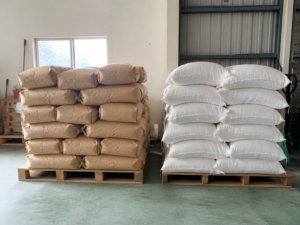
The bag is only the first line of defense—storage methods matter just as much. Storage guidelines from cement manufacturer Aalborg White state that bagged cement should be fully wrapped in plastic film and secured on pallets to prevent moisture absorption from below, and placed on a raised platform about 10 to 20 cm off the ground; cement stored for extended periods should be tested before use, and any that has formed stone-like lumps should not be used (see Aalborg White storage guidelines). India's JK Cement offers more hands-on jobsite storage recommendations: keep dry, raise at least 150mm off the ground, stack no more than 10 bags high, ensure ventilation, and use first-in-first-out rotation (see JK Cement on-site storage guide). Both of these are general field principles rather than guidance for specific bag types, but they align with the same logic behind bag surface design: moisture protection needs to be addressed from the bag to the pallet together, and stacking height needs to be considered alongside anti-slip performance.
| Item | Best Practices | References |
|---|---|---|
| Off ground | Raise pallet 10–20 cm or at least 150 mm | Aalborg White, JK Cement |
| Stacking | No more than 10 bags per stack | JK Cement |
| Moisture protection | Wrap pallet completely with plastic film and keep dry with good ventilation | Aalborg White, JK Cement |
| Shipment order | First in, first out; avoid extended storage | JK Cement |
| Long-stored cement | Test before use; do not use if hardened chunks present | Aalborg White |

Labeling is equally important and shouldn't be overlooked. According to promotional materials from the Hualien Branch of the Bureau of Standards, Metrology and Inspection (BSMI), CNS 61 for Portland cement was revised and published on July 30, 2021, with amendments to the packaging and labeling provisions adding requirements for batch numbers or manufacturing dates, along with regulations on shipping documentation (see BSMI CNS 61 promotional materials). So what information needs to be printed on the bag should be confirmed together with your own shipping and labeling requirements during the design stage, to avoid discovering there isn't enough room for all the fields after the bags are already printed.
Four things to prepare before requesting a quote
The more complete the information when requesting a quote, the more accurate the spec recommendations will be. If you're already evaluating new bags, we suggest preparing four things in advance: first, the fill weight—25kg, 40kg, or another spec; second, the filling equipment, including machine model and filling speed, which determines whether micro-perforation is needed and how the bag should be designed; third, warehouse and transport conditions—whether bags will be stored outdoors, whether they'll go through a humid season, how many layers are stacked on a pallet, and whether export is involved; and fourth, printing requirements, including the number of colors and what information needs to be printed. Once these four points are clear, we can provide a meaningful spec recommendation within one business day, rather than sending back a generic quote.
If your procurement specifications require sustainably sourced materials, feel free to mention this when requesting a quote. Chia Huang holds FSC sustainable material certification and can use FSC-certified materials as needed, along with providing certification documents for audit purposes. For quality management, we are ISO 9001 certified, and we can also prepare the documentation needed for supplier evaluations.
Cement bag printing, plate fees, and minimum order quantity
Cement bags can be printed in up to four colors, with brand logos and spec information printed directly on the bag surface. Print color affects pricing: the number of colors, print area, number of plates, and production quantity all influence plate-making and printing costs—generally, more colors mean higher costs. New designs require plate-making; once cumulative orders within a year reach 50,000 bags, the plate-making fee can be deducted from the order total. The minimum order quantity for custom production starts at around 5,000 bags; if you want to introduce a new size or treatment, this quantity is a good way to validate the spec before committing to larger volumes.
Frequently Asked Questions About Cement Bags
How many layers should 25kg and 40kg cement bags have?
There's no fixed answer—it depends on the packaging weight, material structure, product characteristics, and actual usage requirements. Common practice is: 25kg bags made of plain kraft paper typically use 3 plies, 40kg bags typically use 4 plies, and three-in-one composite kraft paper usually only needs 2 plies to meet most requirements. We recommend a suitable structure based on application, filling method, and transport and stacking conditions.
Is waterproofing coating always necessary for cement bags?
Not necessarily. Whether lamination is needed depends on warehouse humidity, how moisture-sensitive the contents are, and the intensity of transport and handling. Short-term indoor storage and outdoor, cross-seasonal storage have very different requirements, and the type and thickness of lamination will be adjusted accordingly—we recommend specifying these conditions when requesting a quote.
Are micro-pores for gas venting always required for cement bags?
For customers using high-speed automatic filling machines (valve bag method), we strongly recommend adding micro-perforation; otherwise, air pressure inside the bag has nowhere to escape, which can easily burst the bag or cause unstable filling. For manual filling or slower semi-automatic equipment, this can be assessed based on actual conditions.
What's the difference between sewing seams and heat-sealed OverTape?
Sewn seams offer higher strength and are suited to heavy loads and applications that need to withstand drop impacts, making them the most common choice. Heat-sealed OverTape provides better sealing performance, suited to applications with strict requirements on dust leakage. The two methods can also be combined, with OverTape applied after sewing for added sealing strength.
Can cement bags be printed? Does printing color affect the price?
Yes, Chia Huang offers four-color printing. Print color affects pricing, as printing costs vary depending on the number of colors, print area, number of plates, and production quantity—generally speaking, more colors mean higher plate-making and printing costs. We can recommend a suitable printing configuration based on your budget and product requirements, balancing quality, visual impact, and cost.
How should bagged cement be stored to prevent moisture absorption and caking?
The key principles are: dry, elevated, ventilated, and first-in-first-out. Raise pallets off the ground, wrap with plastic film, avoid stacking too high in a single pile, and minimize storage time as much as possible. Cement stored for extended periods should be tested before use, and any that has formed lumps should not be used. These practices, combined with the bag's moisture protection and anti-slip design, help minimize the risk of moisture damage.
Conclusion: Choosing the right cement bag starts with your application
Choosing the right cement bag ultimately comes down to answering a few key questions: how much weight, what filling equipment, where it's stored, how high it's stacked, and how far it travels. Once these conditions are clear, ply count, lamination, micro-perforation, anti-slip coating, and seam sealing method all follow naturally. To see the full range of specs and customization options, check out the Construction Materials Packaging page; once you have your fill weight, filling equipment, storage conditions, and printing requirements ready, feel free to reach out via Contact Us—Chia Huang will respond with spec recommendations and pricing direction within one business day.