Plastic reduction is a term that has come up often in corporate procurement discussions and brand sustainability reports over the past few years, and the question that follows is usually: should packaging switch from plastic to paper bags? At Chia Huang Paper, we've been making industrial paper bags since 1973, working with kraft paper, laminates and woven fabric all along, so we'd like to look at this question from a manufacturing perspective and make it more practical.
Let's start with the conclusion: switching to paper bags is one option for plastic reduction, but it isn't the best solution in every situation. This article first reviews where Taiwan's official plastic reduction policy stands and what its latest direction is, then draws on research from the United Nations Environment Programme to explain the trade-offs between paper and plastic, and finally returns to industrial packaging to discuss when switching to paper bags makes sense—and when it's better not to switch yet.
Plastic Reduction Policy Roadmap: From Bans to Precision Reduction
To discuss plastic reduction policy, it helps to first look at what the authorities have said, paying close attention to the years involved, since the direction has shifted noticeably over the past few years. According to the results page of the Ministry of Environment's Source Reduction Life Action Network, controls on plastic shopping bags and disposable plastic tableware began in 2002 (ROC year 91). On that page, the usage volume of regulated plastic shopping bags dropped from 3.43 billion per year to 1.43 billion; after the expanded plastic restriction policy in 2018 (ROC year 107), 7 more regulated categories were added (see Ministry of Environment Source Reduction Life Action Network).
Next come beverage cups and straws. According to that page, the competent authority announced the restricted targets and implementation method for single-use beverage cups in April 2022 (ROC year 111), and starting September 1, 2024 (ROC year 113), beverage shops in every county and city have banned single-use plastic beverage cups; single-use straws were announced in 2019 (ROC year 108). The table below lays out these key years together.
| Year | Policy Highlights | Source |
|---|---|---|
| 2002 (ROC Year 91) | Regulation of shopping plastic bags and disposable plastic tableware begins | Source Reduction Life Action Network |
| 2018 (ROC Year 107) | Expanded plastic restriction policy, adding 7 new categories of shopping plastic bags under regulation | Source Reduction Life Action Network |
| 2019 (ROC Year 108) | Single-use straws announced under regulation | Source Reduction Life Action Network |
| 2022 (ROC Year 111) April | Announced restrictions on single-use beverage cups and implementation methods | Source Reduction Life Action Network |
| 2024 (ROC Year 113) September 1 | Beverage shops across all counties and cities implement ban on single-use plastic beverage cups | Source Reduction Life Action Network |
| 2025 (ROC Year 114) December 29 | Released 2035 plastic reduction new approach, expanding regulated items from 4 to 6 categories | Ministry of Environment press conference |
The latest shift came at the end of 2025. The Ministry of Environment held a press conference on the "2035 New Thinking on Plastic Reduction" on December 29, 2025 (ROC year 114), explaining that the policy will move away from being primarily ban-and-restriction based, toward precision plastic reduction that combines resource circulation, source design and behavioral guidance. Using 2024 as the baseline year, the reduction targets are set at a 5% cut in single-use petrochemical plastic products by 2030 and a 10% cut by 2035, with the number of managed categories expanding from 4 to 6, adding retail packaging and e-commerce packaging (see Ministry of Environment 2035 New Thinking on Plastic Reduction Press Conference). For retail and e-commerce packaging, the approach involves lightweight packaging, single-material design, use of recycled materials, and right-sized packaging principles.
There are two points worth noting for corporate procurement teams. First, the six managed categories are shopping bags, tableware, beverage cups, straws, retail packaging and e-commerce packaging; the page does not specify the scope of application, and industrial heavy-duty packaging bags are not listed among them. Second, the Ministry of Environment has shifted its focus from primarily bans and restrictions to running bans and restrictions alongside circular design, which means the packaging discussion is extending from "whether it can be used" to "how it should be designed." Based on the public information we've reviewed, whether to reduce plastic in industrial packaging currently looks more like a choice for brands and supply chains to make; whether your customers or export markets have their own packaging requirements is something you'll need to confirm separately with them or the relevant authorities.
Shopping Bag Research Considerations: How the UN Environment Programme Sees Paper and Plastic
The United Nations Environment Programme published "Single-use plastic bags and their alternatives" in 2020, compiling seven life-cycle assessment studies. One of its conclusions is that how many times a bag is used directly affects its environmental impact. The report also points out that banning single-use plastic bags in favor of other single-use alternatives creates environmental trade-offs; for example, single-use paper bags have a lower impact than single-use plastic bags in terms of littering, but tend to have a higher impact in most other categories such as climate change, acidification, eutrophication, ozone depletion and land-use change. However, if paper bags are reused, or if the papermaking process uses recycled fuel or the bags are incinerated, their climate performance may improve; these trade-offs should be assessed within specific geographic and environmental contexts (see the United Nations Environment Programme report).
It should be made clear that this report discusses shopping bags, not 25kg industrial heavy-duty packaging bags, so the figures cannot be directly applied. But the attitude it offers is worth borrowing: no material is inherently good or bad—environmental performance depends on how it's used, how many times it's used, and local waste management conditions. The report includes a very grounded line: the shopping bag with the lowest environmental impact is the one you already have at home. Applied to industrial packaging, from a manufacturing standpoint, one of the most wasteful situations is when a bag isn't suited to its purpose, resulting in bag failure, moisture damage, caking or the need to repackage.
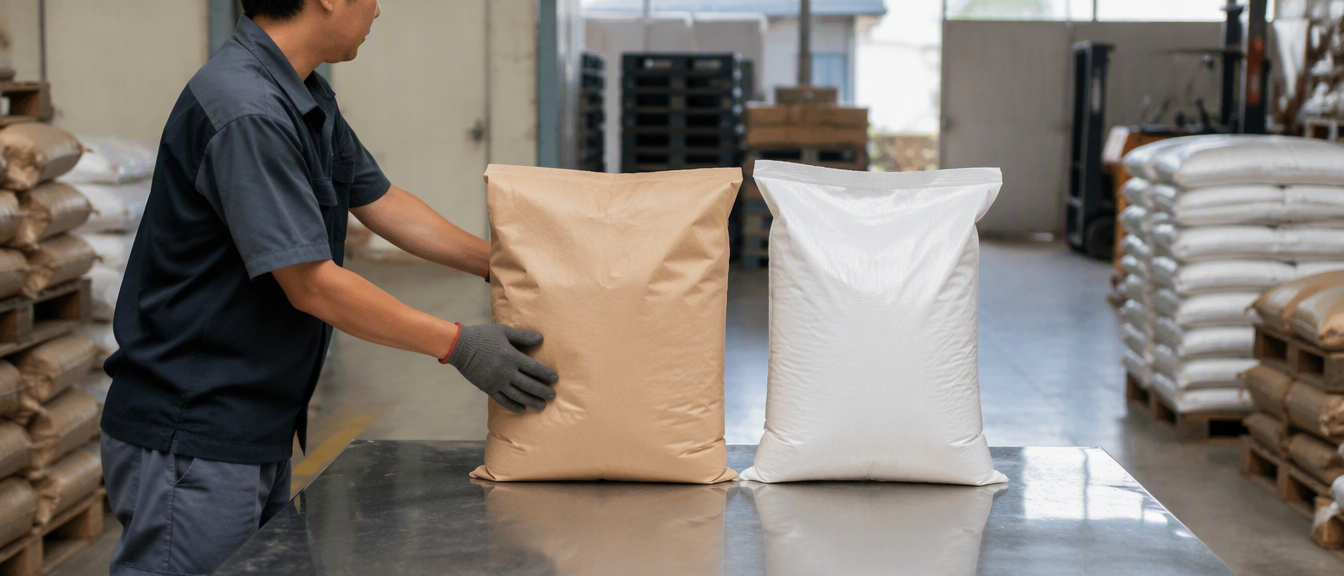
Our own product line uses both paper and plastic: paper bags are based on long-fiber kraft paper, with optional PE or PP lamination for moisture protection, and for conditions like heavy loads or overseas export, we offer composite bag materials combining kraft paper laminated with PE/PP woven fabric. So we won't claim one material is inherently better—it depends on what the contents and usage conditions require. The table below shows how we assess whether a paper bag is suitable.
| Assessment Factor | Conditions Where Paper Bags Usually Work Best | Conditions Worth Further Evaluation |
|---|---|---|
| Storage environment | Indoor, dry environments, short circulation periods | Monsoon season, outdoor storage, or hygroscopic contents—consider laminated or composite structures |
| Transportation and Stacking | Standard heavy packaging; single kraft paper at 25 kg typically uses 3 layers, 40 kg typically uses 4 layers | Ultra-heavy loads, rough handling, or overseas export—woven fabric composite structures offer superior tear resistance |
| Filling and Sealing | Can be paired with micro-hole venting, stitching, and heat-seal OverTape | Contents requiring complete hermetic sealing need separate structural evaluation |
| End-of-Life Processing | Paper-based material processed according to local regulations | When using laminated or composite structures, recycling classification may differ—confirm with local environmental authorities |
The conditions in this table aren't thresholds—they're a checklist of questions to ask when requesting a quote. Even at the same 25kg weight, the answer differs between cement, powder and feed, which is why we always ask about the use case before quoting.
How to Assess Sustainable Packaging: Converting Plastic Reduction Principles into Procurement Questions
As mentioned earlier, the principles the Ministry of Environment has proposed for retail and e-commerce packaging are lightweighting, single-material design, use of recycled materials, and right-sized packaging. These principles are listed under retail and e-commerce packaging on the page, with no mention of industrial bags, so they shouldn't be treated as regulatory requirements for industrial bags—but they do make a useful framework for checking sustainable packaging. The table below turns them into questions you can ask suppliers directly during procurement, along with the information Chia Huang can provide on each point.
| Plastic Reduction Principle | Corresponding Question for Industrial Paper Bags | Information Jia Huang Can Provide |
|---|---|---|
| Lightweighting | Are the number of layers and paper weight just sufficient, rather than adding extra layers for safety? | Paper bags range from 1 to 5 layers, recommended based on contents, filling, transportation, and stacking conditions |
| Single Material | Do you really need lamination or composite structure? | Lamination is an optional single-layer treatment; film material can be PE or PP; composite bags address more demanding conditions |
| Use of Recycled Material | Can the paper source be selected? | Supply recycled kraft paper and virgin kraft paper; can specify FSC-certified raw materials and provide certification documents |
| Optimal Packaging | Does the specification match filling lines and pallet conditions? | 25 kg and 40 kg are common specifications, adjusted based on actual use conditions |
The results page of the Source Reduction Life Action Network also notes that policies restricting excessive packaging are expected to guide packaging toward simpler materials and lighter weight, with the Ministry of Environment estimating on that page a reduction of 7,300 metric tons of packaging waste per year. This figure is a policy projection and shouldn't be extrapolated to any individual factory, but the direction aligns with our approach: packaging should be just enough, without unnecessary layering. For paper material sourcing, you can first check Chia Huang's Paper Materials & Raw Materials page to learn about the supply options for recycled kraft paper and virgin wood pulp kraft paper.
Before Switching to Paper Bags: Suitable, Unsuitable, and Not Yet Cases
Switching to paper bags tends to work better when the contents are mainly powder or granules, storage is mostly indoors, turnover periods are short, and the brand or customer specifically wants paper-based packaging. In these cases, plain kraft paper or multi-layer paper bags with lamination can usually meet load-bearing, moisture-protection and printing needs at the same time; kraft paper surfaces can be printed in up to four colors, allowing brand and spec information to be printed directly on the bag.
There are also plenty of situations where it's better to hold off on switching, or at least evaluate further: long-term outdoor storage, overseas export, heavy loads, high moisture absorption, or contents that require a complete moisture barrier. Under these conditions, switching to paper bags may require reinforcement through lamination or composite structures, or even a full reassessment of the packaging format. If your current packaging is working fine, the most honest advice is to not switch yet, because changing packaging materials isn't just about swapping bags—it also affects compatibility with filling lines, pallet stacking stability, and sealing methods.
Prepare Before Inquiry: Building a Foundation for Plastic Reduction Assessment
If you're considering switching to paper bags, we recommend preparing the following information first: the type of packaging currently used, weight and dimensions per bag; whether the contents are powder, granules or another form, and how sensitive they are to moisture; the filling method—high-speed automatic filling is best paired with micro-perforated venting, while manual filling can be assessed separately; storage and transport conditions; and any specific sustainability requirements from your customers or market, such as whether FSC certification documentation is needed.
If the bag surface needs printing, please let us know your requirements as well. Printing color affects price: the number of colors, print area, number of plates, and order quantity all influence plate-making and printing costs. Chia Huang can recommend a printing setup based on your budget and needs, balancing brand presentation with cost. The more complete the information, the more targeted our recommendations can be within one business day—rather than a generic quote.
Frequently Asked Questions about Plastic Reduction and Paper Bags
Will plastic reduction policies require industrial packaging bags to switch to paper?
Based on the plastic reduction direction announced by the Ministry of Environment on December 29, 2025, the six managed categories are shopping bags, tableware, beverage cups, straws, retail packaging and e-commerce packaging—industrial heavy-duty packaging bags are not included. That said, your customers or export markets may have their own packaging requirements, so it's best to confirm with them or the relevant authorities.
Is switching to paper bags always more environmentally friendly than plastic bags?
Not necessarily. Research compiled by the United Nations Environment Programme in 2020 found that single-use paper bags have a lower impact in terms of littering, but tend to have a higher impact in most other environmental categories such as climate change; that report focuses on shopping bags, and results should be assessed based on usage conditions and frequency of use.
Can Chia Huang's paper bags be made with recycled paper or FSC-certified materials?
Chia Huang supplies recycled kraft paper and virgin wood pulp kraft paper, and can also specify FSC-certified raw materials with certification documentation provided; actual specifications are assessed based on use case. For paper material supply options, please see the Sustainability & Circular Economy page.
Paper bags require coating for moisture protection—does that still count as plastic reduction?
Lamination involves coating the paper surface with a thin layer of PE or PP film, so it does contain plastic. Whether lamination is needed depends on the moisture sensitivity of the contents, storage environment and turnover period; for applications that don't require moisture protection, it's possible to go without lamination and rely on a multi-layer kraft paper structure for load-bearing and protection instead. For applications requiring moisture protection, the film material and thickness can be selected based on the contents and storage conditions.
What should you confirm before switching to paper bags?
First confirm the weight and moisture sensitivity of the contents, the filling method, storage and transport conditions, and whether printing is needed. High-speed automatic filling is best paired with micro-perforated venting, while pallet stacking requires assessing anti-slip treatment and sealing design together.
Conclusion: Plastic reduction isn't just about swapping materials; it's about getting packaging design right
Looking back at this overview, the direction of plastic reduction is actually quite clear: official policy is moving from being primarily ban-and-restriction based toward running alongside circular design, while academic research reminds us that no material is inherently good or bad. Both point to the same thing—choosing the right packaging based on usage conditions. For industrial paper bags, this means using just enough layers, applying lamination only when needed, being able to specify paper sourcing and obtain documentation, and making sure everything matches up with filling, stacking and sealing conditions. If you'd like to assess whether paper bags suit your product, feel free to check out our Sustainability & Circular Economy page first, then head to Contact Us and tell us about your contents, weight per bag, filling method, storage environment and sustainability requirements—Chia Huang will respond with spec recommendations within one business day.