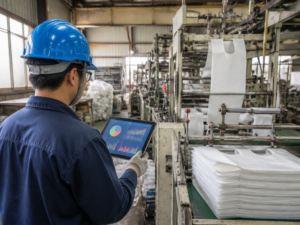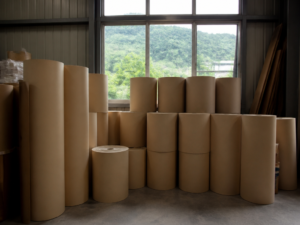
Circular economy is often oversimplified as "doing more recycling," but according to the Resource Circulation Administration under the Ministry of Environment, it actually refers to a complete resource mindset spanning design, manufacturing, use and reuse, with the goal of creating more value from fewer resources. For a paper bag factory, this concept isn't far removed from daily operations: turning rolls of kraft paper into bags through bag-making and printing inevitably produces scrap material, and the real question is simply where that scrap ends up.
This article first explains the definition of circular economy using government sources, along with the Resource Circulation Promotion Act that passed its third reading in June 2026. It then turns to our own manufacturing floor at Chia Huang Paper, looking at how scrap material is sorted and reused, using circular upcycled products as a concrete example. Finally, it outlines questions that procurement and ESG teams can ask suppliers. Regulations and definitions are all sourced; Chia Huang's practices are limited to what is already published on our official website, and any figures not publicly disclosed are not included in this article.
What is Circular Economy? Understanding the Difference Between Linear and Circular Economy
In its article "Understanding the Circular Economy," the Resource Circulation Administration describes the traditional linear economy as a one-way process of "extract, manufacture, use, discard," and defines the circular economy as a mindset centered on resource regeneration and environmental sustainability. Ways to advance this include sustainable consumption and production, improving resource use efficiency, adding value to waste treatment, developing circular business models, green product design, building circular cooperation networks, and energy and resource recovery—all aimed at reducing raw material consumption and creating more value from fewer resources, moving toward "zero waste through resource circulation" (see Resource Circulation Administration, "Understanding the Circular Economy").
The same page also introduces two approaches from an industry perspective. One is industrial symbiosis, where companies share raw materials, energy, by-products, water and metals with one another. The other is industrial circulation, which covers material selection, product design, process optimization, by-product recovery, treatment and regeneration, sorting and collection, refurbishment or remanufacturing, and repair and reuse. This list is a reminder that circularity doesn't begin only after a product has been used up—it starts right from material selection and design.
| Comparison Factors | Linear Economy | Circular Economy |
|---|---|---|
| Resource Flow | One-way process of extraction, manufacturing, use, and disposal | Resource regeneration mindset that reduces raw material consumption |
| Design Focus | Emphasis on manufacturing and usage stages | Green and circular product design, considering future reuse from material selection |
| Manufacturing By-products | Treated as waste to be disposed | By-product resource recovery, with industrial symbiosis with other companies when necessary |
| End-of-Life Direction | Disposal | Collection, refurbishment, remanufacturing, repair, and reuse |
The linear economy process shown in the table above is drawn from the Ministry of Environment's explanation; the remaining columns are this article's summary based on that content. Applied to paper bag manufacturing, the difference between linear and circular comes down to two questions: whether leftover material from the process counts as a resource, and whether room was left for downstream processing when the product was designed. The sections that follow examine these two questions.
What Manufacturers Should Know About the Resource Circulation Promotion Act
According to a press release issued by the Ministry of Environment on June 2, 2026 (Republic of China year 115), the former Resource Recycling and Reuse Act was renamed the Resource Circulation Promotion Act and passed its third reading that day; the Presidential Office Gazette shows the act was promulgated on June 17, with Article 14 and Article 38, Paragraph 1 taking effect two years after promulgation, while the remaining articles take effect immediately upon promulgation. The new law's core direction is "source reduction, resource circulation," with management scope covering a product's entire life cycle from design, production and consumption through to recycling and reuse; the government will draft a national resource circulation plan and establish a cross-ministerial Resource Circulation Promotion Committee (see Ministry of Environment press release).
Of particular relevance to product and packaging supply chains are several mechanisms established under the new law: for designated products, requirements may include ease of disassembly, single-material construction, or use of a minimum proportion of recycled content; it also promotes circular labeling and product information disclosure, covering recycled content ratio, durability, repairability and recycling methods, with the government giving priority to procuring circular products. However, the press release also notes that related sub-regulations and supporting measures have yet to be established, so which products will be designated and to what extent remains subject to future announcements by the competent authority.
At this stage, the more practical approach isn't to guess in advance what requirements packaging might face, but to treat "clearly documenting material information and being able to account for where process scrap goes" as a basic foundation. When procurement teams later require information disclosure, whether a supplier already has records on hand will determine how quickly they can respond. This is a judgment we make from the manufacturing side, not a provision of the new law.
Circular Economy in Paper Bag Factories: Starting from Raw Materials and By-products
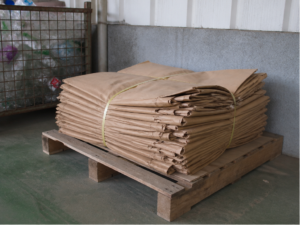
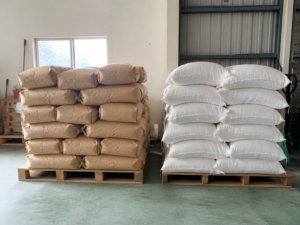
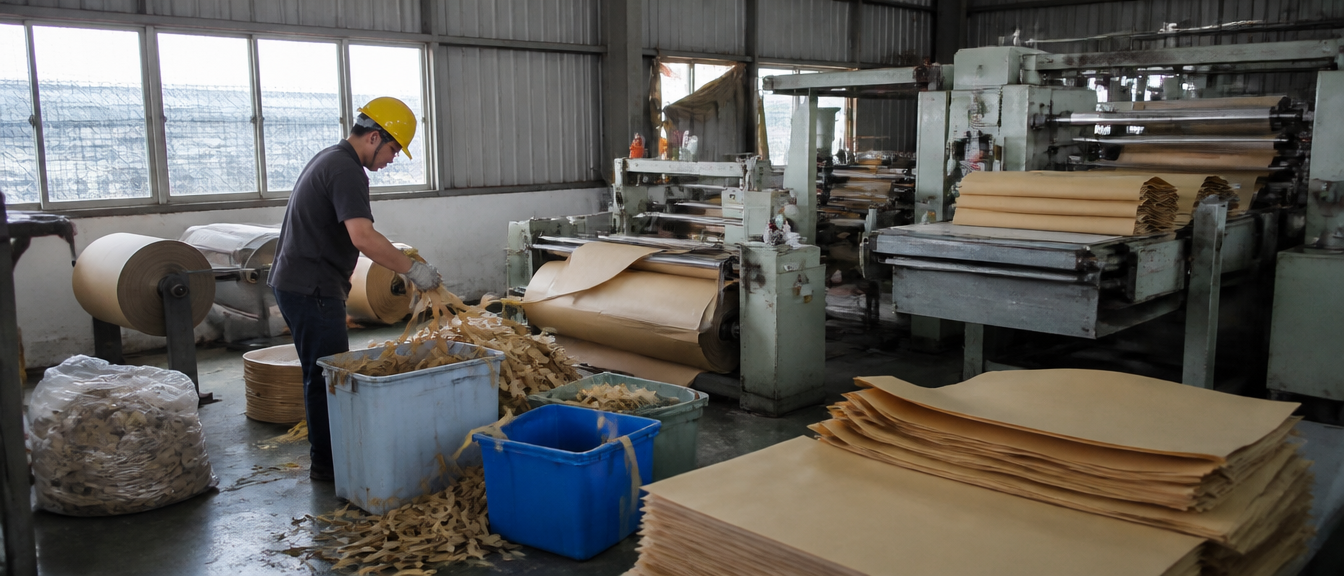
Mapping the industrial circulation steps listed by the Ministry of Environment onto a paper bag factory, the two stages that are easiest to put into practice are front-end material selection and by-product recovery during the process. Chia Huang's official website divides its approach into three layers—source, process and end-of-line (see Sustainability and Circular Economy): at the source, raw materials can be specified as FSC-certified with supporting certification documents provided; during the process, scrap material is collected and reused; and at the end-of-line, scrap that cannot be directly reprocessed and bag material that doesn't meet printing specifications are converted into circular upcycled products.
It isn't hard to work out where the scrap comes from. Processing rolls of kraft paper into bags of fixed dimensions inevitably leaves leftover material from cutting, printing and bag-making, and bag material whose printing doesn't meet specifications may not be shippable either—both of these roughly correspond to the scrap from bag-making and printing, and the off-spec bag material mentioned on the official website. The website doesn't disclose the volume of scrap or the recycling ratio, so this article doesn't use figures to describe it, and we won't fabricate a recycling ratio either.
Whether scrap material is suitable for reuse also depends on its condition. Based on material composition, unprinted, unlaminated pure kraft paper scrap has a simple composition and is the easiest to sort; scrap that has been printed or laminated requires considering how to handle the ink and plastic film first. This is a judgment based on material properties—actual sorting and recycling methods depend on each facility's process.
Circular Economy Case: How By-products Become Creative Products
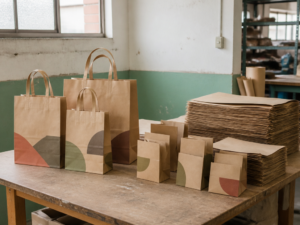
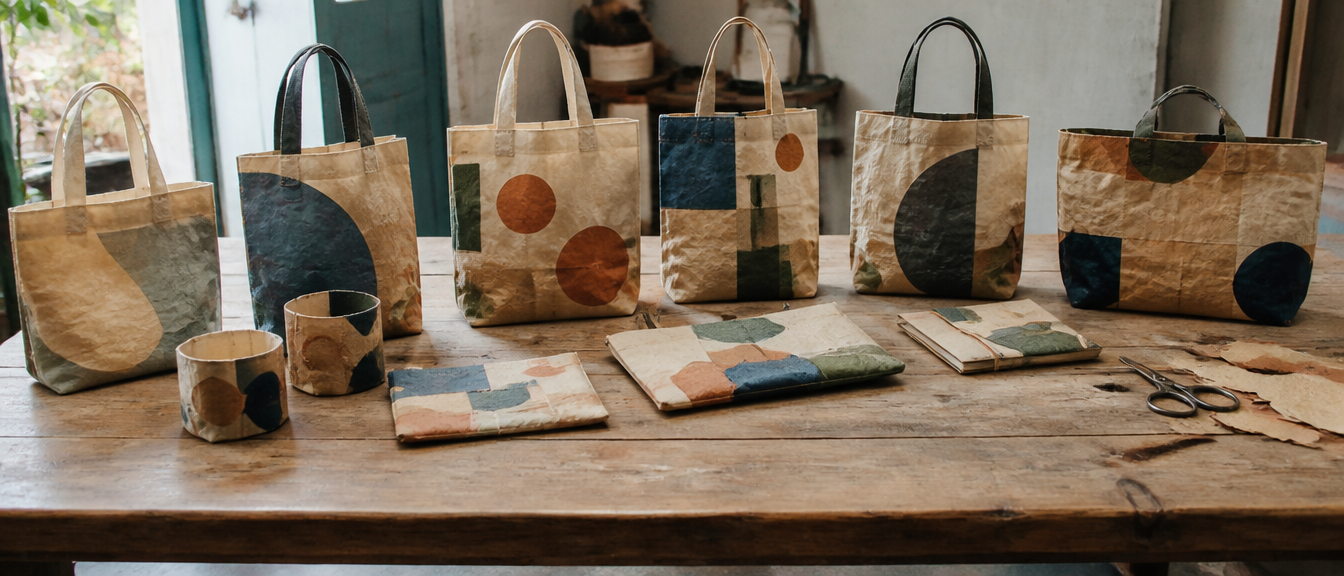
Among Chia Huang's circular economy case studies, the most concrete and visible is our circular upcycled products. The official website describes a four-step process: scrap and off-spec bag material generated during production; recyclable materials are screened out instead of being discarded; new uses are assigned through design, turning them into upcycled products; and finally, the scrap material gets a second life. The second step in this process is "screening." Logically, not every type of scrap is suitable for reprocessing—screening and sorting first ensures a stable supply of material for downstream design and reprocessing. Please confirm actual practices with sales.
The official website currently lists three product directions: reusable eco-friendly bags made from kraft paper and scrap material, branded paper products customized to brand identity and needs, and circularly designed items suited to serving as an ESG storytelling medium for businesses. Customization use cases include corporate gifts, event souvenirs, or branded merchandise meant to convey an ESG commitment. In 2021, Chia Huang's circular upcycled product program won the Manager Today 100 MVP Product Innovation Award, recognizing its achievements in reusing scrap material. For a full introduction to these products, see Circular Upcycled Products.
| Product Direction | Materials and Design | Suitable Applications | Confirm Before Inquiry |
|---|---|---|---|
| Recycled Eco-Friendly Tote Bags | Made from kraft paper and by-products | Eco-friendly tote bags for daily use that balance practicality with sustainability | Styles and quantities must be confirmed case by case; feasibility will be assessed by our sales team |
| Custom Brand Paper Products | Customized design based on brand characteristics and requirements | Corporate gifts, event souvenirs | Usage, quantity, and whether brand printing is needed |
| ESG Circular Design Products | Recycled paper products designed with circular economy concepts | Serves as a vehicle for ESG stories and sustainability commitments | Message to convey, and whether the by-product source can be explained |
If you'd like to print a brand design on upcycled products, please check feasibility with sales first, and note that printing color will affect price: the number of colors, print area, number of plates and quantity all affect plate-making and printing costs. Chia Huang can recommend a printing configuration based on your budget and needs, balancing brand presentation with cost. Additionally, for circular upcycled products, please have sales assess and confirm styles, actual quantities and lead times based on your requirements—when inquiring, please specify the intended use and timeline first.
Coating, Single Material, and Recycling: Trade-offs in Circular Design
Packaging inevitably involves trade-offs in material composition. As mentioned earlier, the green design system under the Resource Circulation Promotion Act may require designated products to be easy to disassemble, made of a single material, or contain a minimum proportion of recycled content. On the other hand, heavy-duty paper bags often need lamination or composite materials for moisture resistance. These two directions pull against each other, and there's no universal answer—trade-offs depend on the specific use case.
For recycling guidelines, you can refer to the New Taipei City Resource Recycling Information Network (2022 page) on paper containers: paper cups and containers laminated with PE plastic film are not recycled together with the four general paper categories—white paper, mixed paper, newspaper and kraft paper—but are instead classified separately as paper containers, where a specialized processing facility separates the plastic film from the paper first (see New Taipei City Resource Recycling Information Network). Note that this page addresses paper containers, not industrial paper bags; how industrial paper bags should be handled after use still needs to be confirmed with local recyclers and end users based on their own processes.
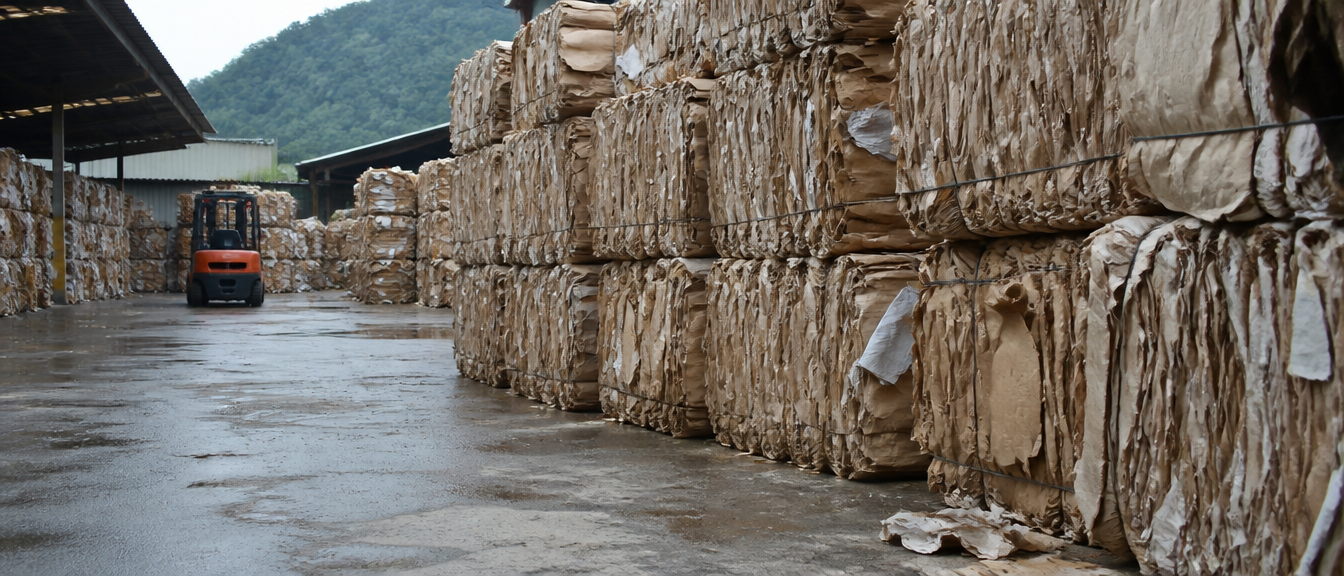
From a manufacturing standpoint, the more practical approach is: don't add lamination as a precaution if the contents and environment don't require moisture resistance, since lamination is a single-layer process intended for moisture resistance, abrasion resistance and barrier protection—there's no need to add it when these functions aren't required. When moisture resistance is needed, keep the film type and thickness within the range that's just sufficient. On the raw material side, confirm the paper source first—for example, specifying FSC-certified material, or choosing Chia Huang's recycled kraft paper when strength and application allow. The point of these principles is to let resources take a shorter path at the design stage, not to sacrifice protection for the sake of single-material form.
How Procurement and ESG Teams Ask Questions to Suppliers
To judge how solid a paper bag supplier's circular practices really are, what matters isn't the slogans in a presentation deck, but whether their documentation can answer a few concrete questions. The table below lists common lines of inquiry, the reasoning behind them, and the documents you can request from suppliers; the portion already disclosed by Chia Huang is limited to the FSC documentation mentioned earlier, along with our scrap material and circular upcycled product practices.
| Question Areas | Why Ask | Request Suppliers to Provide |
|---|---|---|
| Are there sustainable sourcing requirements for raw materials? | Material information addressing green supply chain and ESG procurement | Can specify the use of FSC-certified materials and provide certification documents |
| How are manufacturing by-products handled? | Whether by-products are discarded, recycled, reused, or remanufactured | Explanation of by-product recovery, reuse, and circular creative practices; contact sales directly for any available percentages or quantities to disclose |
| Does the bag style have coating or composite materials? | Affects the ease of downstream recycling sorting | Structural and usage explanation to confirm whether contents truly need moisture protection |
| Do you need circular creative products or gifts? | Serves as a vehicle for ESG storytelling | Usage, quantity, brand direction, and whether printing is needed |
When asking these questions, you can also draw on the regulatory context above. The product information disclosure framework planned under the Resource Circulation Promotion Act covers recycled content ratio, durability, repairability and recycling methods, which by law may be designated by the competent authority as applicable to specific items or their packaging and containers. Which packaging will be designated is still pending further announcements, but having material information ready in advance is useful for both ESG reporting and supplier audits. When requesting a quote, it's best to specify the contents, usage environment, whether moisture resistance is needed, and whether printing is required, so that sales can assess structure, materials and circular practices together.
Frequently Asked Questions About Circular Economy
What's the difference between circular economy and general recycling?
Recycling is just one part of the circular economy. According to the Resource Circulation Administration, it encompasses sustainable consumption and production, green product design, circular business models, and energy and resource recovery, all aimed at reducing raw material consumption. In other words, it starts from material selection and design, not after a product is discarded.
How are paper bag factory by-products handled?
According to Chia Huang's official website, scrap generated during the manufacturing process is collected and reused, while scrap that cannot be directly reprocessed and bag material that doesn't meet printing specifications are remade into circular upcycled products. For specific sorting methods, styles and quantities, please confirm with sales.
Can circular creative products be customized with brand design?
Yes. Chia Huang can provide upcycled eco-friendly paper bag designs tailored to brand identity and needs, for uses including corporate gifts, event souvenirs and ESG-themed merchandise. When inquiring, please specify the intended use, quantity and brand direction, and let us know if printing is required—sales will assess feasible options.
After the Resource Circulation Promotion Act was passed, must paper bags be made from recycled materials or single materials?
Not yet. The Ministry of Environment's press release states that the green design system applies to designated products and may require ease of disassembly, single-material construction, or a minimum proportion of recycled content, but as of the June 2026 press release, sub-regulations and supporting measures are still pending. Which products will be designated will depend on future announcements from the Ministry of Environment.
Has Chia Huang published the proportion of waste material reuse or tonnage reduction?
Chia Huang's Sustainability and Circular Upcycling page does not list this kind of figures, so this article doesn't provide any either. If your ESG report requires quantitative data, please contact sales directly to ask what can be disclosed, rather than citing unconfirmed figures.
Conclusion: Circular economy requires visible material flow
Back to the question we started with: the circular economy isn't complete just because recycling is sorted properly—every stage, from material selection and design to process scrap and final use, needs a traceable destination. For a paper bag factory, specifying FSC-certified raw material sources, recycling scrap for reuse, and converting what can't be reprocessed into circular upcycled products represent the three layers of practice currently published on our website. Quantitative data such as ratios and volumes should be provided separately by the supplier based on actual circumstances. If you're planning sustainable procurement or want to create a batch of circular upcycled products, feel free to visit Contact Us and let us know the intended use, quantity, brand direction and whether printing is needed—our sales team will respond within one business day.