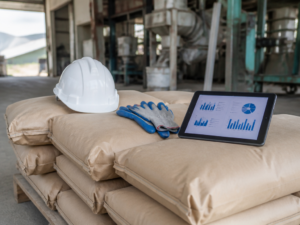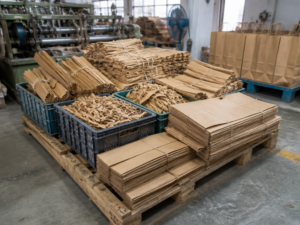
The term "space bag" (太空包) has two completely different meanings in Taiwan. One refers to "mushroom space bags" used in agriculture for mushroom cultivation; the other refers to large flexible containers used industrially to hold sand, grain, and bulk powder materials — known as FIBCs (Flexible Intermediate Bulk Containers). This article discusses the latter.
How different are the two? According to the Ministry of Agriculture's Agricultural Knowledge Portal article "Mushroom Cultivation Techniques – Shiitake," mushroom space bags are made by pressing sawdust and other growing substrate into PP plastic bags, typically weighing about 1.4 to 1.6 kg each. Since 1974, Taiwan has gradually shifted from log cultivation to space bag technology (see Ministry of Agriculture Agricultural Knowledge Portal). Industrial FIBCs, on the other hand, are containers used to transport and store entire batches of bulk powder or granular materials — the two simply share the same name.
Chia Huang Paper's core business is 25kg and 40kg heavy-duty kraft paper bags, as well as composite bag materials made of kraft paper laminated with woven fabric via extrusion coating — we do not manufacture finished FIBC bulk bags. The only FIBC-related offering on our website is extrusion coating: one common application of PE woven fabric is FIBC, meaning we can provide extrusion coating services for woven fabric. So this article is written from the perspective of a heavy-duty paper bag manufacturer, explaining when switching to FIBCs is worth considering. General information is cited with sources; anything beyond the cited sources reflects our own views.
What Are Space Bags (Industrial FIBCs): Structure, Capacity & Standards
Industrial FIBCs are governed by an international standard. ISO 21898:2024 "Packaging — Flexible intermediate bulk containers (FIBCs) for non-dangerous goods" specifies requirements for FIBCs designed to be lifted from the top and used to hold non-dangerous powdered, granular, or paste-like solids. It covers materials, structural and design requirements, type testing, and labeling requirements, and also provides guidance on selection and safe use. The second edition was published in August 2024, replacing the 2004 edition (see official ISO page). In other words, an FIBC is a container specification with defined testing and labeling requirements — not simply a "bigger bag."
The ICPP's Flexible Intermediate Bulk Container — Frequently Asked Questions defines FIBCs in more accessible terms: the body of an FIBC is made of flexible woven material (typically polypropylene); once filled, it is handled by forklift, crane, or hoist, and is designed to be lifted from the top via loops, slings, or sleeves. It is used to transport powdered, flaked, or granular solids without requiring additional packaging. A single FIBC typically holds about 500 to 2,000 kg (the ICPP source states 1,000 to 4,000 lbs) (see ICPP FIBC FAQ). Converting this range, 500 kg is equivalent to 20 bags of 25 kg each, and 2,000 kg is equivalent to 80 bags.
| Comparison Item | 25 kg Heavy-Duty Paper Bags | Industrial Space Bags (FIBCs) |
|---|---|---|
| Single Unit Capacity | Common sizes are 25 kg and 40 kg | Typically 500 to 2,000 kg per unit |
| Handling Method | Handled bag by bag, stacked neatly on pallets | Lifted by loops, straps or sleeves; transported by forklifts, cranes or hoisting equipment |
| Primary Material | 1 to 5 layers of long-fiber kraft paper | Flexible woven material, typically polypropylene (PP) |
| Moisture Protection | Optional PE or PP coating | Coated fabric available, or combined with inner lining film |
| Filling Method | Bag opening fitted to filling machine; high-speed automatic filling with optional microporous venting | Suspended from filling apparatus; filling and discharge methods vary based on top and bottom design |
| Does Chia Huang Supply? | Yes | No; we only offer lamination services for woven fabrics |
The most critical difference is the shipping unit. 25kg paper bags are individually packaged and then assembled onto pallets, whereas an FIBC is itself a shipping unit designed for bulk, large-volume handling. So the choice isn't about which is more "advanced" — it's about whether your logistics and downstream equipment need to change accordingly.
When It Makes Sense to Switch from Paper Bags to Space Bags
Whether to switch shouldn't be based on volume alone. A more practical approach is to work backward from the downstream side: how does the customer receive goods, what equipment is used for unloading, how is warehouse stacking handled — then decide on the packaging format. The table below outlines several decision factors. The word "tends to" is used deliberately, as no single factor can serve as the answer on its own.
| Decision Factor | Lean Toward Keeping Heavy-Duty Paper Bags | Lean Toward Considering Space Bags |
|---|---|---|
| Single Shipment Volume | Orders vary in quantity, or customers receive by bag | Large batch of single product; customers receive by ton |
| Downstream Receiving Equipment | Bag opening lines, or manual/semi-automatic bag opening | Already equipped with suspended discharge systems such as forklifts, hoisting frames or discharge stations |
| Product Form | Powder or granules acceptable; requires division and sale by bag units | Dry, flowable powder or granular materials |
| Storage & Stacking | Neat stacking on pallets, standard practice for bagged goods | Must stack according to design specifications; not all FIBCs can be stacked |
| Number of Uses | Single-use only | Only consider reusability when needed: single-trip types are not reusable; reusable types must meet requirements with a minimum safety factor of 6:1 |
Take cement as an example — the ICPP lists cement, sand, and clay among the common dry, flowable products carried in FIBCs. However, whether to switch to bulk bags still depends on whether the downstream process involves bulk discharge into a storage tank or sale and construction use by individual bag. For the moisture protection, anti-slip, and sealing design needed for bagged cement, see our Cement & Building Materials Packaging page.
Handling & Hoisting: Space Bags Aren't Just Bigger Bags
The strength of a paper bag is determined by the paper material and number of layers; the strength of an FIBC is determined by the overall design of its lifting loops, fabric, and stitching. According to the ICPP, Safe Working Load (SWL) is the weight a bag is designed to carry, determined by the FIBC's design, stitching method, and fabric strength, and printed on the manufacturer's label. Per the labeling requirements cited by the ICPP from EN ISO 21898:2005 (ISO 21898 now has a 2024 edition — refer to the current version for applicable requirements), bags must carry durable markings including the SWL (in kg) and safety factor, such as 5:1, 6:1, or 8:1. This means switching packaging formats also means switching to a different specification language — inquiries are no longer about the number of layers, but about SWL and safety factor.
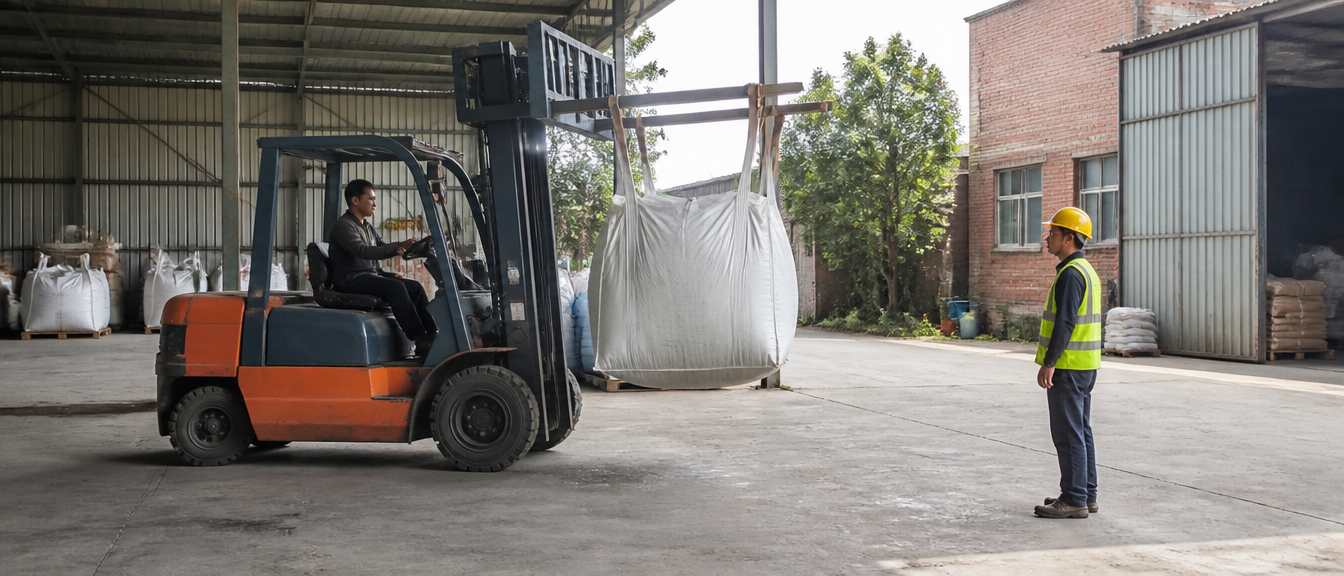
Lifting procedures also follow specific rules. The ICPP notes that most transport damage results from improper lifting — lifting and lowering should be symmetrical, avoiding sudden jerks and swinging, and bags should never be lifted directly with steel cables or fiber ropes, as the lifting loops could tear. Forklift forks should have no sharp edges and should be covered when necessary. These are all operational adjustments that must be made on-site when adopting FIBCs.
Filling & Discharge: Your Entire Production Line Needs Reconfiguration
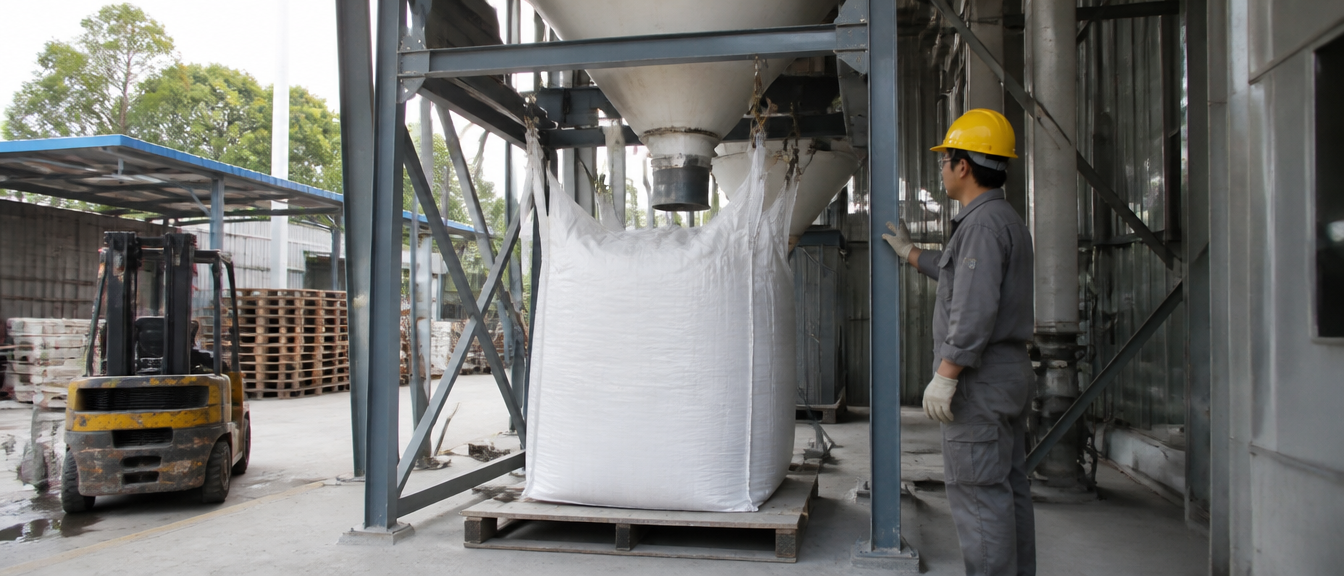
Paper bags are filled by fitting the bag opening over a filling spout, with air escaping through micro-perforations during high-speed automatic filling. FIBCs, on the other hand, are hung on a filling device. The ICPP lists top designs including open top, duffle top, conical top, and spout top, with bottom designs including duffle bottom, conical bottom, and flat bottom. The choice depends on the filling method, equipment clearance, filling speed, and whether discharge will be by gravity, auger, or conveyor.
There are additional details to consider during filling. According to the ICPP, the bag should be suspended from the filling device during the process, with the bottom touching or close to the ground or pallet, and any discharge spout should be closed beforehand. To keep the bag stable under load, filling height should be between 0.5 and 2 times the bag's shortest horizontal dimension. Another important consideration is static electricity: static charge can build up during filling or discharge, which under certain conditions may cause an explosion — hence the Type B, C, and D antistatic bags (Type B offers only limited protection with no static dissipation mechanism), which must be tested and labeled according to IEC 61340-4-4. If the contents are hazardous materials or combustible dust, a qualified supplier must assess the situation according to relevant regulations — this falls outside the scope of general bag selection and is not something we can determine on your behalf.
Storage & Moisture Protection: Space Bags Fear Sunlight & Rain Too
Industrial FIBCs are not necessarily more durable in storage. The ICPP points out that stacking is only appropriate for bags designed to be stackable and confirmed stable, using either pyramid stacking or wall-supported stacking. Exposure to UV light and weather conditions such as rain and snow should also be avoided, as prolonged exposure weakens the bag's strength. It is not recommended to store empty or filled bags outdoors; if unavoidable, they should be covered with protective material, and there is no guarantee that unprotected bags left outdoors can still be safely handled. This aligns with the same logic as heavy-duty paper bags — "outdoor stacking requires a moisture protection assessment first." Regardless of the packaging format, warehouse conditions must always be factored in.
Regarding moisture protection, the ICPP explains that coated fabric has a layer of PP added to the inner or outer side to reduce moisture penetration or powder leakage. Fine powder leak-prevention structures are typically combined with coated fabric and filler cord stitched into the seams, and may also include an inner liner. What Chia Huang can provide is the extrusion coating process for woven fabric: our website lists FIBC as one application of PE woven fabric lamination. It should be noted that the FIBC fabric described by the ICPP is typically PP, while our website lists FIBC under applications of PE woven fabric — the pairing of film and base material depends on actual specifications. Please provide the fabric material and intended use when requesting a quote, so our sales team can assess feasibility. For details, see Extrusion Coating Services.
If your needs fall between paper bags and woven fabric — for example, requiring more durability than a plain paper bag but not needing ton-scale capacity — you may also want to consider our Composite Bag Materials: a structure made of kraft paper laminated with woven fabric, suitable for extra-heavy loads, overseas export, rough handling, and long-term outdoor stacking.
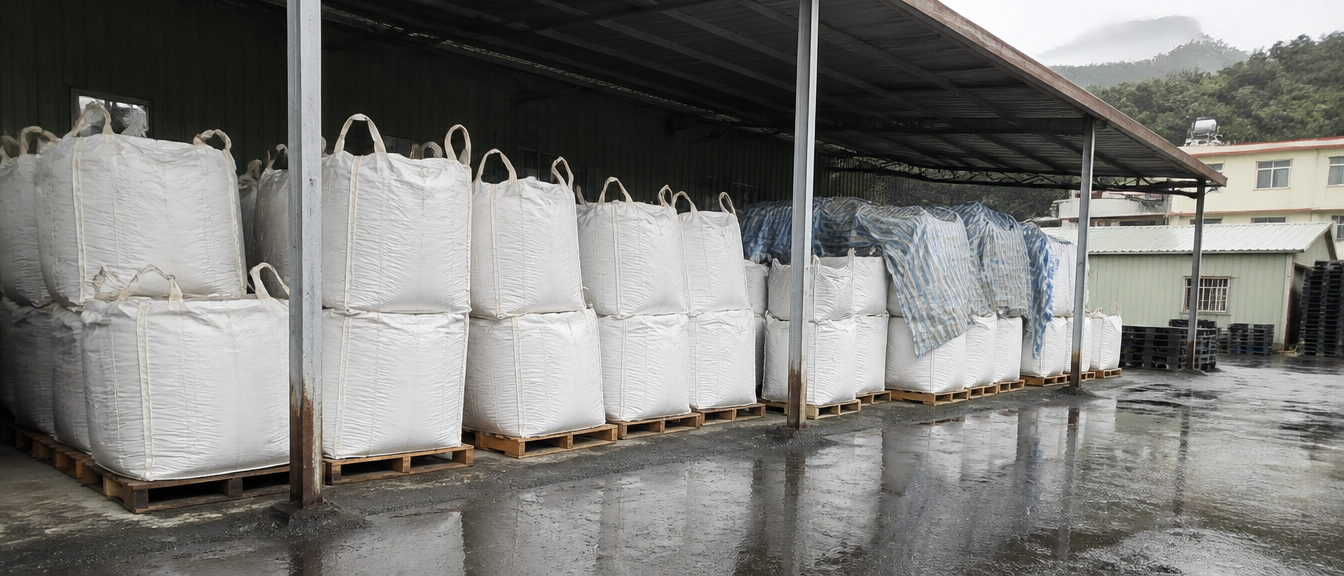
Gather This Information Before You Decide
Whether you ultimately choose paper bags, composite bag materials, or FIBCs, the following information forms the basis for comparison: the characteristics of the contents, including particle size, flowability, moisture absorption, and whether static or hazard risks are present; the volume per shipment and how it's received downstream; the equipment conditions for filling and discharge; and the warehouse environment and stacking method. If the contents are food ingredients, relevant food contact regulations and certification requirements should also be separately confirmed.
Frequently Asked Questions About Space Bags
Are industrial space bags and mushroom growing bags the same thing?
No. Mushroom space bags are small plastic bags used in agricultural cultivation, typically weighing about 1.4 to 1.6 kg each. Industrial bulk bags, on the other hand, are large containers made of woven material that can be lifted by loops, typically holding about 500 to 2,000 kg. The two simply share the same name — this article discusses the industrial type.
How much can one industrial space bag hold?
According to the ICPP, an FIBC typically holds about 500 to 2,000 kg, with size, handling, filling, discharge, and barrier features customizable to requirements. The actual load capacity depends on the Safe Working Load (SWL) indicated on the bag's label.
Does Chia Huang manufacture space bags?
No. We manufacture heavy-duty kraft paper bags and composite bag materials, primarily in 25kg and 40kg sizes. The FIBC-related service on our website is extrusion coating for base materials such as PE woven fabric. If you need finished FIBC products, we will let you know directly that this is outside our manufacturing scope.
Can space bags be stored outdoors?
Not recommended. According to the ICPP, UV light and weather conditions weaken the strength of FIBCs, so storing empty or filled bags outdoors is not advised. If unavoidable, bags should be covered with protective material, and there is no guarantee that unprotected bags left outdoors can still be safely handled.
Are there "FDA-approved" space bags?
According to the ICPP, the US FDA does not issue approvals or certifications for FIBCs, so "FDA-approved" bulk bags do not exist. If the contents are food ingredients, relevant food contact regulations and certification requirements should be separately confirmed, and your own and downstream users' requirements should be discussed with the supplier.
Conclusion: Space Bags Aren't an Upgrade to Paper Bags—They're a Different Specification Altogether
FIBCs and heavy-duty paper bags solve logistics problems at different scales: 25kg and 40kg paper bags are suited to bag-by-bag distribution, while bulk bags suit large-volume, batch handling with lifting equipment available. Before switching packaging formats, confirm the downstream receiving and unloading equipment, filling line, warehouse environment, and content characteristics — not just the unit price.
If you're evaluating FIBCs versus paper bags, feel free to visit our Contact Us page and tell us about your contents, quantity per batch, filling method, and warehouse environment. After assessment, if 25kg or 40kg heavy-duty paper bags or composite bag materials remain suitable, our sales team will respond with recommendations within one business day. If you need finished FIBC products, we will let you know directly and assess whether our woven fabric extrusion coating service can help.