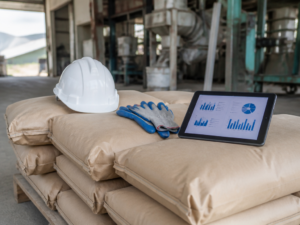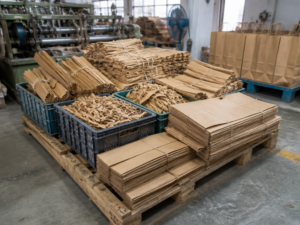
Put a woven bag and a kraft paper bag side by side, and it's tempting to simplify it to "plastic is more durable, paper is more eco-friendly." Both statements have some truth, but neither is enough for actual purchasing decisions. What determines the right choice is how much weight the bag needs to hold, whether it will be stored indoors or outdoors, and whether it's for export.
Chia Huang Paper is a kraft paper bag manufacturer, and we don't produce pure plastic PP woven bags as finished products. However, we do offer a product line that sits between the two: a composite bag material made by laminating kraft paper onto PE/PP woven fabric, listed on our site as PE/PP Woven Bags. This position allows us to explain the differences and trade-offs between the three structures from a manufacturing perspective. This article compares kraft paper bags, standard PP woven bags, and composite bag materials side by side in a single table, then discusses the scenarios each is best suited for.
What is a woven bag? Understanding the difference between woven fabric and woven bags
What's generally referred to as a PP woven bag is a bag sewn from woven fabric made of polypropylene (PP). For food-grade materials, there's a dedicated standard: ISO 23560:2015, "Woven polypropylene sacks for bulk packaging of foodstuffs," which specifies the general characteristics, requirements, and test methods for such bags. It applies to 50 kg or 25 kg bags used to transport and store food raw materials like grains, sugar, and beans. This edition was reconfirmed as still valid after its 2025 review (see the official ISO page).
The following two points are our own judgment, not part of the standard itself. First, woven bags and paper bags belong to different product categories, each with its own specifications and test methods, so the inspection language for one shouldn't be applied to the other. Second, the 25 kg weight class it covers happens to be the most common specification for heavy-duty paper bags as well, which naturally puts the two bag types in comparison at this weight class. If the contents are food raw materials, regardless of which bag type you choose, you should separately confirm relevant food-contact regulations and certification requirements.
Woven bags, kraft paper bags and composite bag materials: comparing three structures
Let's first define the terms. In the table below, "standard PP woven bag" refers to a bag sewn from PP woven fabric, while "composite bag material" refers to Chia Huang's structure of kraft paper laminated onto woven fabric. Chia Huang does not manufacture the former as a finished product, so that column lists only general industry information and does not endorse any specific product.
| Comparison Item | Heavy-duty kraft paper bags | Standard PP woven bags | Kraft paper laminated composite woven fabric |
|---|---|---|---|
| Primary material | 1 to 5 layers of long-fiber kraft paper | PP woven fabric | Kraft paper, PE or PP lamination, PE or PP woven fabric |
| Strength source | Long-fiber paper and multi-layer lamination | Woven fabric | Woven fabric provides tear-resistance strength |
| Moisture Protection | Optional PE or PP coating | Depends on whether coating is applied | Lamination layer provides moisture protection; choose PE or PP based on requirements |
| Outer layer printing | Up to 4-color printing available | Varies by manufacturer | Outer kraft paper layer allows 4-color printing |
| Most suitable scenarios | General heavy-duty storage indoors, typically more economical | Evaluate based on each manufacturer's specifications | Extra-heavy load, ocean export, rough handling, long-term outdoor storage |
| Does Chia Huang manufacture this? | Yes | No, we do not manufacture pure plastic woven bags | Yes |
The differences between the three structures mainly come down to three questions: where the strength comes from, how moisture is managed, and whether the surface needs printing. Kraft paper bags rely on long fibers and multi-ply lamination to distribute stress; composite bag materials incorporate woven fabric into the structure, giving far higher tear resistance than pure paper bags. As for standard woven bags, strength likewise comes from the woven fabric, but detailed specifications vary by manufacturer—check the actual specs provided when requesting a quote.
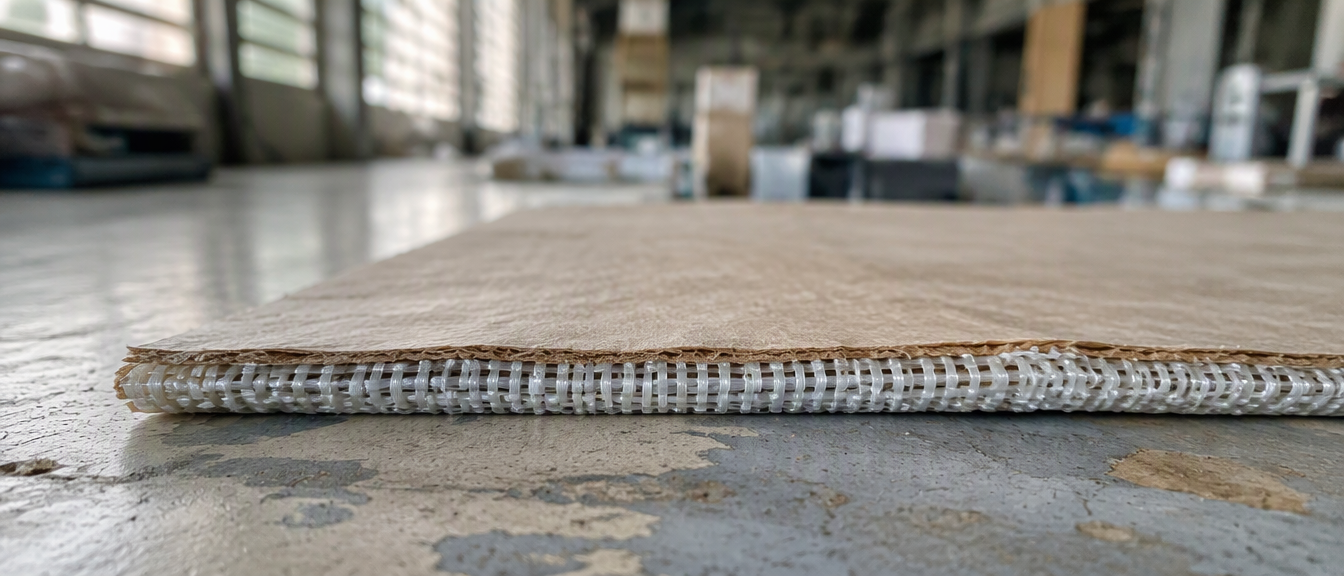
Tear resistance: what provides it—long fibers in paper or woven fabric?
The tear resistance of paper bags comes from two sources: the inherent toughness of long-fiber kraft paper, and the stress distribution provided by multi-ply lamination. This structure is typically the more economical choice for indoor warehousing and general handling in heavy-duty packaging, and is a reasonable starting point for 25 kg applications. To learn how the layers are configured, see Multi-Layer Paper Structures.
When requirements step up to extra-heavy loads, overseas export, or rough handling—exactly the scenarios listed for composite bag materials—incorporating woven fabric into the structure offers another solution. PE/PP Woven Bags have an inner layer of PE or PP woven fabric, giving far higher tear resistance than pure paper bags, while the outer kraft paper layer still serves as a surface for full-color printing. There's also a middle-ground option: Tri-Laminate Kraft Paper, which balances strength, moisture resistance, and cost—suitable for applications that need more durability than pure paper bags but don't require the highest specification.
The trade-off is straightforward: if you don't need that level of strength, there's no need to pay for it. For general heavy-duty packaging in indoor warehousing, heavy-duty kraft paper bags are usually more economical. Incorporating woven fabric into the structure is meant to address conditions that paper bags struggle with—not a default upgrade for every project.
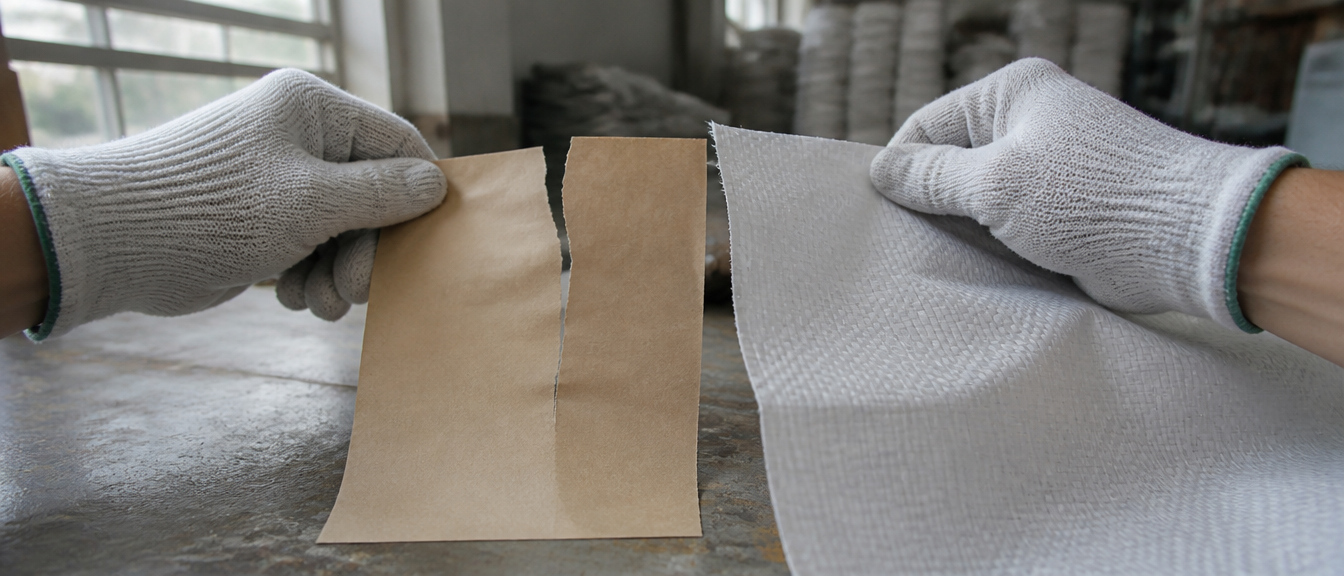
Moisture protection and outdoor storage: the role of lamination
Moisture protection is another consideration for this type of bag. According to the FIBC FAQ published by ICPP (Flexible Intermediate Bulk Container — Frequently Asked Questions), coated bags have a layer of PP added on the inside or outside to reduce moisture ingress or powder leakage of contents—also referred to as non-breathable or laminated fabric and bags—while uncoated bags have no plastic coating. The same FAQ explains that UV protection is achieved by blending additives into the resin before yarn extrusion, and the glossary notes that woven fabric tapes are made by slitting and stretching extruded PP sheets (see ICPP FIBC FAQ). This document concerns FIBCs (bulk bags); we infer that the material and coating logic for woven fabric likely offers useful reference value for standard woven bags as well.
At Chia Huang, lamination is a single-layer process, available in PE or PP. According to our website information, PP woven fabric can be laminated with PP, and PE woven fabric can be laminated with PE, to improve moisture resistance, waterproofing, and durability. If you already have woven fabric and only need the lamination step, we also offer contract processing: send a sample, receive a feasibility assessment within about one business day, confirm specifications and pricing, then proceed to processing. When submitting material, please confirm the woven fabric width first—our lamination equipment handles a maximum width of 2,000 mm and a minimum of 500 mm, and can be slit into two rolls from the center; lamination thickness can be adjusted as needed. For process details, see Lamination Processing Services.
Long-term outdoor stacking is one of the scenarios listed for composite bag materials, but UV exposure and weather aren't only a lamination issue—they also relate to how the woven fabric itself is treated. Our website does not list UV treatment as a standard specification, so if your bags will be exposed to prolonged sunlight, please specify the stacking location, duration, and weather conditions when requesting a quote so our sales team can assess it accordingly.
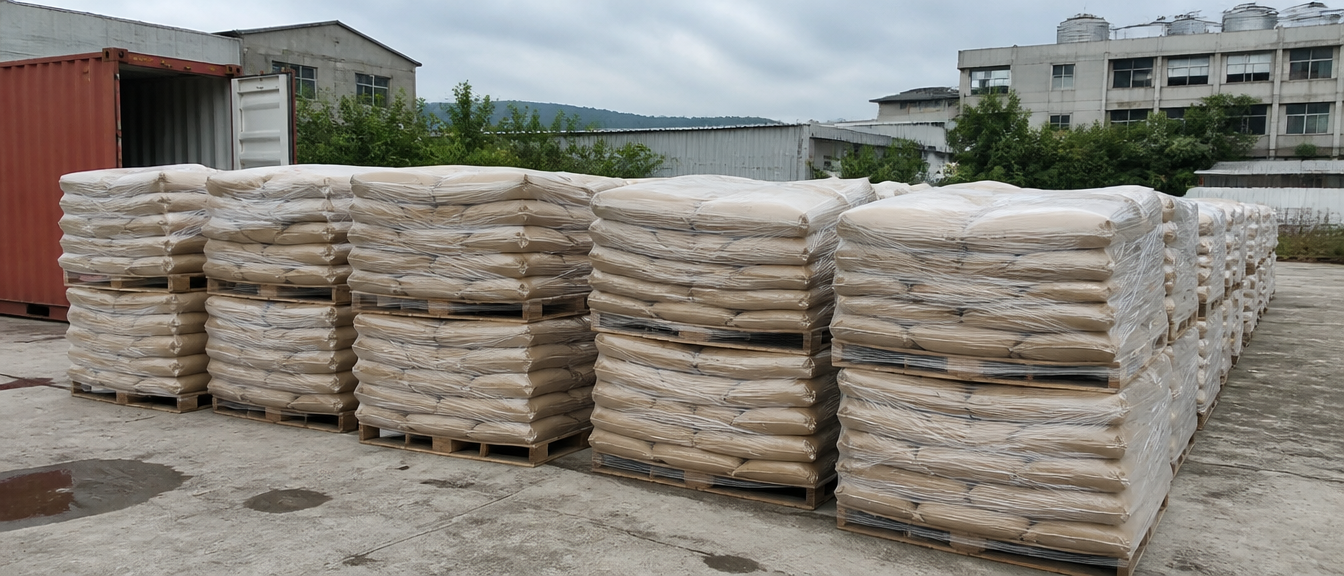
The downstream side of mixed materials: recycling and material selection must be considered together
Before choosing a structure, there's one often-overlooked aspect: what happens after use. A 2023 Greenpeace article discusses takeout paper containers rather than industrial bags, but its explanation of lamination is still useful reference: lamination materials include PE, PP, PLA, and CPE, with PE and PP being the most common laminations for paper containers in Taiwan. Recycling such paper containers requires sending them to specialized waste paper container processing plants to separate the lamination from the paper (see Greenpeace's explanation).
Industrial bags and takeout food containers serve very different purposes and shouldn't be directly equated, but the principle that "paper combined with a plastic film must be separated before recycling" still applies. Composite bag materials add woven fabric on top of paper and film, which likely makes end-of-life processing even more complex—please check with your local recycling operator or environmental authority for the actual recycling channels available. For comparison, the ICPP FAQ notes that FIBCs made of PP fabric can be recycled, as PP material can be mechanically processed without altering its chemical structure, though bags that have come into contact with hazardous substances must not be recycled, and some components may not be fully recyclable either. In our assessment, fabric made primarily of a single PP material has a relatively straightforward recycling path, whereas structures layering paper, film, and woven fabric together must first address material separation. This doesn't mean composite bag materials are a poor choice—it simply reinforces the point that whether to use a composite structure should be driven by actual need; if you don't need extra-heavy-load strength, there's no need to choose it.
How to choose between woven bags and kraft paper bags: comparing by scenario
We recommend starting with three questions to narrow down your options. First, what are the most demanding handling and transport conditions—short indoor moves, or overseas export and rough handling? Second, where will the bags be stored and for how long—indoor warehousing and outdoor stacking have very different requirements for moisture and weather resistance. Third, how much branding information needs to appear on the bag—when the outer layer is kraft paper, full-color printing is possible, and printing requirements will in turn affect cost. The answers to these three questions can help narrow your options down to a few choices before moving on to specifications and quotes.
| Use Case | Recommended option | Reason | Notes |
|---|---|---|---|
| Indoor warehouse storage, 25 kg granular materials | Heavy-duty kraft paper bags | For general indoor warehouse heavy-duty packaging, paper bags are typically more economical | Available with optional lamination, micro-perforations for venting, and anti-slip agent |
| Moisture protection needed, but simple handling conditions | Kraft paper bag with PE or PP lamination | Lamination directly handles moisture protection without modifying the bag wall material | Lamination is a single-layer process and does not count toward layer count |
| Extra-heavy load, ocean export, rough handling | Kraft paper laminated composite woven fabric | Woven fabric provides high tear-resistance strength | Outer layer allows 4-color printing |
| Long-term outdoor storage | Composite bag material; specify storage conditions first | Listed on the website as the appropriate use scenario for composite bag materials | Please specify UV and weather requirements during quotation |
| Strength needed, but not the highest specification | Three-Ply Kraft Paper | Balance strength, moisture protection and cost | Typically 2 layers |
| Need pure plastic woven bag products | Outside Chia Huang's manufacturing scope | Chia Huang manufactures kraft paper bags and composite bag materials | If you already have woven fabric, you can inquire about lamination contract processing |
When requesting a quote, please prepare details on the contents and weight per bag, filling method, storage and transport environment (outdoor exposure, overseas export), and whether printing is needed. The minimum order quantity for custom orders is approximately 5,000 bags. If printing is required, note that print colors affect pricing—the number of colors, print area, number of plates, and quantity all influence plate-making and printing costs. Chia Huang can recommend a printing configuration based on your budget and needs, balancing brand presentation with cost. For specifications and structure details on composite bag materials, see the Composite Bag Materials page.
Frequently asked questions about woven bags
Which is better, woven bags or kraft paper bags?
There's no absolute right or wrong answer—it depends on usage conditions. For general heavy-duty packaging in indoor warehousing, kraft paper bags are usually more economical; for extra-heavy loads, overseas export, rough handling, or long-term outdoor stacking, composite bag materials that incorporate woven fabric into the structure are worth considering. Let us know your contents and environment when requesting a quote, and we'll recommend the right direction.
Does Chia Huang manufacture PP woven bags?
We do not manufacture pure plastic PP woven bags as finished products. What Chia Huang makes is a composite bag material of kraft paper laminated onto PE or PP woven fabric, listed on our site as PE/PP Woven Bags, along with Tri-Laminate Kraft Paper. If you need a pure plastic woven bag, we recommend contacting a specialized manufacturer.
What is the difference between three-in-one kraft paper and PE/PP woven bags?
Both are composite structures of kraft paper laminated onto woven fabric. Tri-Laminate Kraft Paper balances strength, moisture resistance, and cost, suitable for applications that need more durability than pure paper bags but don't require the highest specification; PE/PP Woven Bags are designed for maximum tear resistance. You can choose based on your budget and strength requirements.
I already have woven fabric. Can Chia Huang only provide the coating service?
Yes, feel free to inquire first. Chia Huang's laminating substrates include PP and PE woven fabric. The process is: send a sample, receive a feasibility assessment within about one business day, confirm specifications and pricing, then proceed to processing. Actual feasibility is determined by the assessment results.
Can the outer layer of composite bag materials be printed? Does the printing color affect the price?
Yes, the outer kraft paper layer supports full-color printing. Print colors affect pricing—the number of colors, print area, number of plates, and quantity all influence plate-making and printing costs. Chia Huang can recommend a printing configuration based on your budget and needs, balancing brand presentation with cost.
Conclusion: Choose woven bags or kraft paper bags based on your strength requirements and environmental needs
Woven bags and kraft paper bags aren't about one replacing the other—they're different answers for different conditions. For heavy-duty packaging in indoor warehousing, multi-layer long-fiber kraft paper bags are usually the more economical choice; for extra-heavy loads, overseas export, rough handling, or long-term outdoor stacking, composite bag materials that incorporate woven fabric into the structure have a clear rationale. Our approach is to first understand your conditions, then decide whether upgrading the material makes sense.
If you're comparing woven bags and kraft paper bags, feel free to visit our Contact Us page and tell us about your contents, weight per bag, filling method, storage and transport environment, and whether printing is needed. Our sales team will respond within one business day with structure recommendations and pricing guidance.