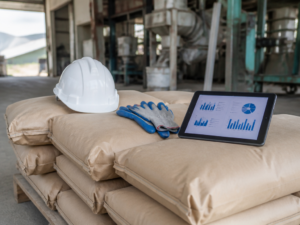
If the bagged cement you have on hand has been sitting for a few months, can it still be used? This is really a question of cement shelf life. After reviewing public resources, we found the answer isn't just about how many months have passed on the calendar — what really matters is whether the cement has been exposed to moisture, how it's been stacked, and what condition it's in when the bag is opened.
Chia Huang Paper has manufactured cement bags and other industrial paper bags since 1973. Rather than comparing ply counts and specs item by item, this article organizes three things from a warehousing perspective: what public resources say about cement shelf life, what to watch for with cement caking, and how on-site storage rules work together with bag design. Let's state this up front, as it runs through the whole article: bags can reduce the risk of moisture exposure, but they cannot vouch for cement's shelf life.
Cement Storage Shelf Life: What Public Data Says
The Portland Cement Association (PCA), in the 15th edition of <em>Design and Control of Concrete Mixtures</em> (2011), opens the "Storage of Cement" section by stating: cement is a moisture-sensitive material, and when kept dry, it maintains its quality indefinitely; cement exposed to damp air or moisture sets more slowly and develops lower strength than cement kept dry (see PCA 15th edition PDF via secement.org). This reframes the question from "how long" to "stored where."
Taoyuan City and Taipei City's construction specifications don't use the term "shelf life." The Taoyuan City Government's published construction specification, Chapter 03052 "Portland Cement," states in its rejection clause: cement that has been inspected and then stored in bulk at the manufacturing plant for a full 6 months, or stored bagged in a local warehouse for a full 3 months before delivery, may be retested (the original text appears to contain a typo; interpreted here according to context); if the retest fails to meet any corresponding CNS requirement, it may be rejected (see Taoyuan City Government Construction Specification Chapter 03052). This is a threshold for "retesting after this period," not an expiry date meaning "cannot be used after this." The same chapter also states that cement showing moisture caking, hardening, or any sign of hardening must not be used under any circumstances.
The Taipei City Government's published construction specification, Chapter 03050 (file dated May 2023), takes a different approach by requiring that, if bagged cement supply is approved by the engineer, the bag must indicate the manufacturer's name, cement type, weight per bag, and manufacturing date (see Taipei City Government Construction Specification Chapter 03050). The table below places all three sources' answers to "how long can cement be stored" side by side.
| Source | What They Say | What This Means |
|---|---|---|
| PCA (USA) | Maintaining dryness preserves quality long-term; moisture causes slower hydration and reduced strength | The key is dryness, not the passage of time |
| Taoyuan City Government Construction Standards | Bagged cement stored in a local warehouse for a full 3 months, or bulk cement stored at the plant for a full 6 months, before delivery may be retested; if it fails, it may be rejected | This is the re-testing timeline, not an expiration date |
| Taipei City Government Construction Standards | Manufacturing date must be marked on the bag; hardened or deteriorated cement cannot be used and must be removed in its entirety | Track by manufacturing date and assess usability based on actual condition |
So to answer "can this batch of cement still be used," the more reliable approach is to look back at two things: whether storage conditions stayed dry, and the actual condition when the bag is opened. For construction use, always follow design documents, supervision, and specification requirements — this article only compiles public information and does not make usability judgments for any project. The manufacturing date is directly useful for warehouse management: only with a date on the bag can you calculate how long a batch has been stored and apply first-in-first-out properly; bags without a date can only be judged by intake records and visual inspection.
Cement Caking Risks: Moisture, Bottom Bags, and Long-Term Storage
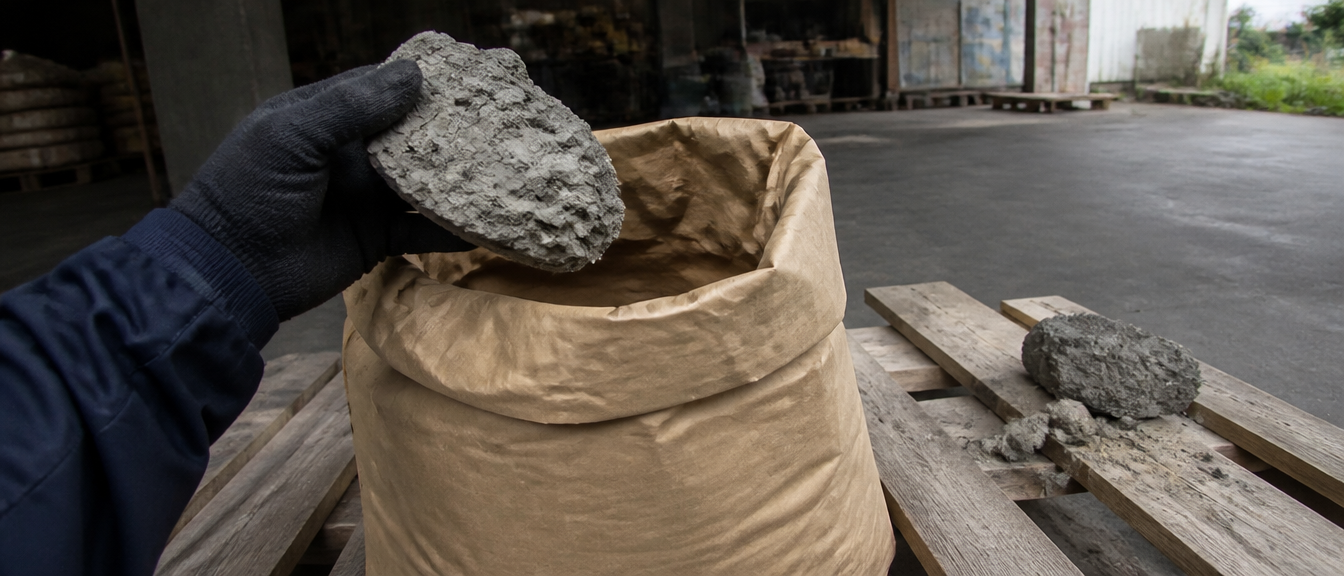
PCA refers to one type of caking that can occur after long-term storage as "warehouse pack," noting that this can usually be corrected by rolling the bag on the ground. Sources differ on recommendations for cement that has already hardened into lumps — construction use should still follow specifications. In use, cement should flow freely with no lumps; if lumps don't crumble easily, important projects should run tests before use, such as a standard strength test or loss-on-ignition test. From this, it can be inferred that warehouse pack formed from long-term storage is a different condition from moisture-induced hardening, and should be handled differently — this is our inference.
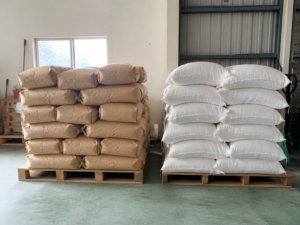
Pay particular attention to the risk of caking at the bottom layer. PCA notes that cement bags should not be placed on damp ground, but on pallets — and pallets that have been rained on can also damage the bottommost bags. Taipei's specification requires that bagged cement have its storage position changed at least once every 2 months, to prevent hardening at the bottom. Both sources specifically mention the bottom layer. As for the reason, the sources don't elaborate; based on stacking logic, we infer that the bottom layer bears both the weight above and ground moisture — this is our inference, not a conclusion from the sources.
| Condition | What Sources Say | Our Summary |
|---|---|---|
| Warehouse pack appears after prolonged storage | PCA: Warehouse pack may occur; usually correctable by rolling the bag | Confirm whether it is warehouse pack first, then check flowability before use |
| Hard lumps that do not crumble easily | PCA: Testing before use is recommended for critical projects | Do not judge by appearance alone; base decisions on test results |
| Moisture-induced caking and hardening | Taoyuan and Taipei standards: cannot be used; Taipei standard also requires complete removal | Follow standards on construction sites; isolate and dispose immediately |
| Bottom bags hardened | Taipei standard: reposition at least every 2 months; PCA: wet pallets damage bottom bags | Rotate positions and keep pallets dry |
The third column is our summary based on sources and does not represent the original source text; the source's original statements are in the second column
On-Site Storage Rules: Common Points and Differences Among Sources
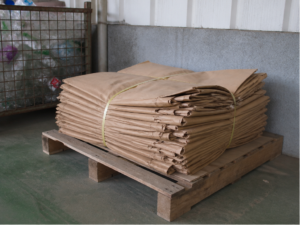
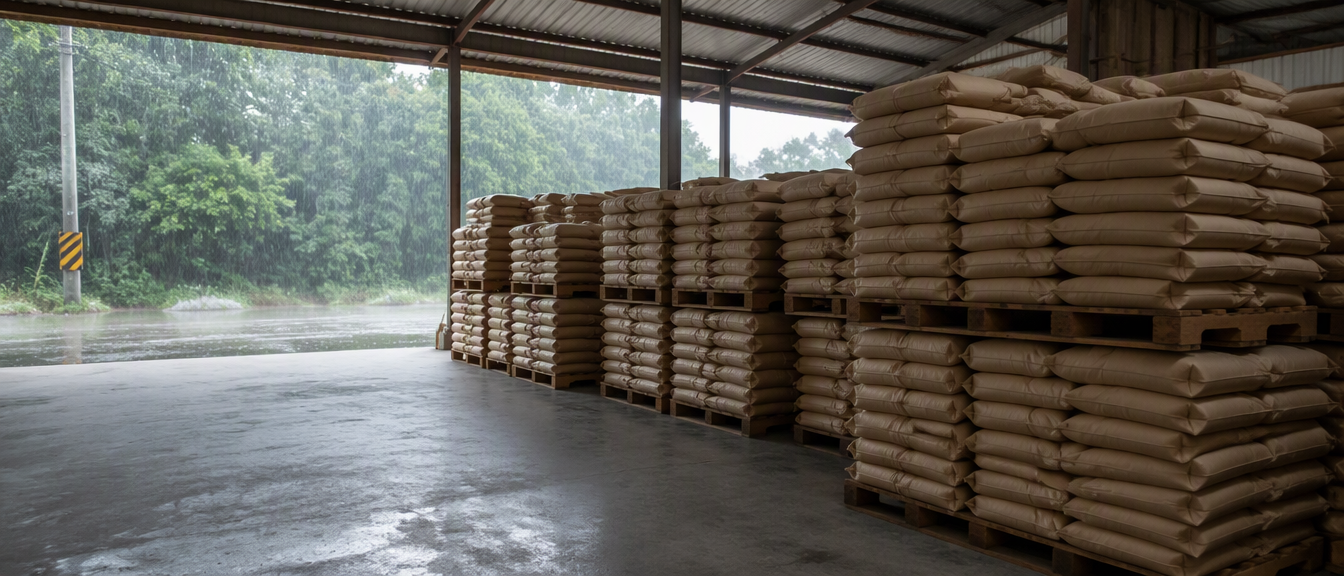
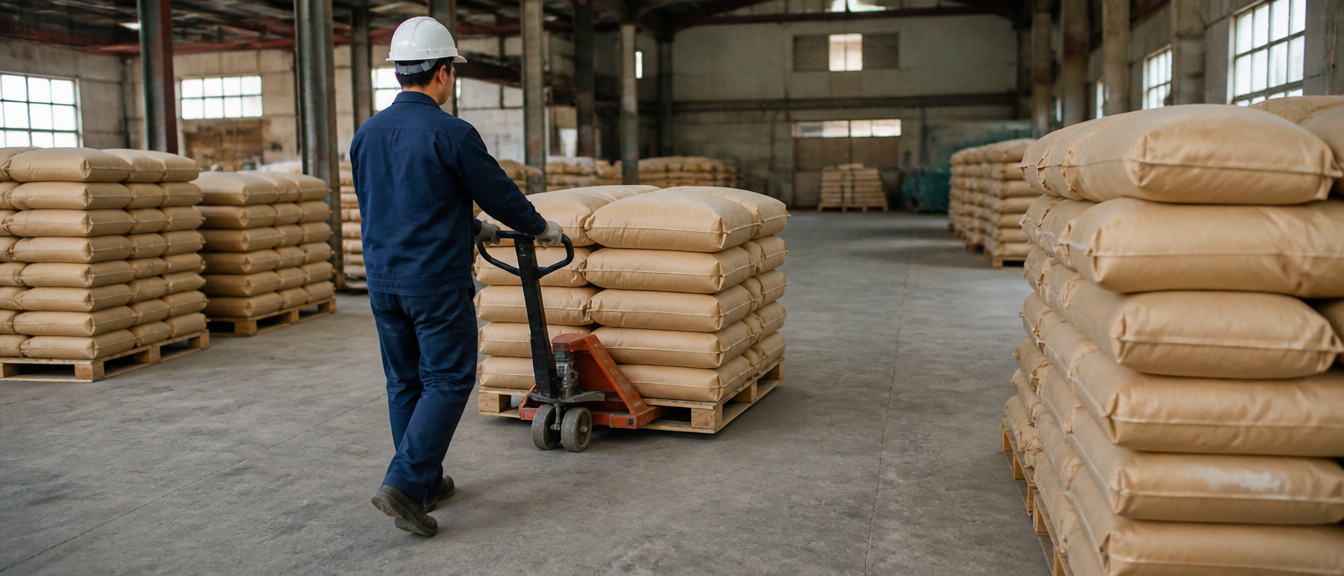
Taiwan's two specifications share a similar general direction for bagged cement, but differ in required wall clearance and position-change frequency. Taipei's specification requires bagged cement to be stored indoors or in another location free from rain exposure, at least 20 cm off the ground with good ventilation, stacked no higher than 10 bags, following first-in-first-out principles, with designated personnel managing it; an aisle of at least 1.0 meter must be kept between bagged cement and the warehouse's side walls, and aisles must also be kept within the storage area so all cement is visually accessible, with each batch stored separately and used in order of arrival. Taoyuan's specification similarly requires a well-ventilated, waterproof, moisture-proof building, with bagged cement placed on boards at least about 20 cm off the ground and at least 30 cm from walls, stacked no higher than 10 bags in principle, and used in order of arrival.
Different sources emphasize different things. PCA recommends that warehouses or sheds storing bagged cement maintain as low a relative humidity as possible, with cracks and openings in walls and roofs sealed; bags should be stacked tightly together to reduce air circulation, but not placed directly against exterior walls; long-term storage should be covered with tarpaulins, following first-in-first-out. Taiwan's specifications emphasize good ventilation and require clearance between bagged cement and walls; PCA, by contrast, recommends stacking bags tightly to reduce air circulation, while also avoiding direct contact with exterior walls. Both require clearance from walls, but differ in their approach to ventilation. Which approach suits your warehouse should be determined by site specifications, supervision requirements, and local humidity conditions — here we only summarize what the sources say, without drawing conclusions for your specific site.
What Bag Design Can and Cannot Do
All of the above concerns conditions outside the bag itself. Bags don't guarantee an extended cement shelf life — what they can do is add a layer of protection on top of these conditions, reducing the chance of moisture exposure and stacking problems. Moisture-resistant options include PE lamination, PP lamination, and lamination for woven fabric: these add a physical waterproof barrier outside the paper layers, so that during brief moisture exposure, the bag is less likely to soften from water penetration. The type and thickness of the lamination are selected according to storage conditions. Lamination is a single-layer treatment and isn't counted among the 1 to 5 paper plies of a paper bag; whether to apply lamination depends on storage humidity, the contents' sensitivity to moisture absorption, and handling strength. To learn how to select different treatments, see the Functional Treatments page.
Micro-perforation requires an extra consideration. Micro-perforation is designed to let air escape from the bag during high-speed automatic filling; the pore size is engineered to let air out while keeping powder from leaking. The Functional Treatments page also explains that for contents requiring moisture protection at the same time, a moisture-barrier treatment can be combined with it. So if a cement bag is expected to be stored for a longer period, micro-perforation and moisture-barrier lamination should be evaluated together, not decided separately. Anti-slip agents increase surface friction on the bag to reduce the risk of pallets sliding or collapsing during handling or transport when stacked high; this isn't a moisture-protection measure in itself, but stable stacking reduces the chance of bag damage and moisture exposure caused by collapse.
| Risk | On-Site Practices | Bag Surface Design Options |
|---|---|---|
| Ground or wall moisture seepage | Pallets elevated 20 cm or more above ground, with clearance from walls | PE coating, PP coating, or woven fabric coating |
| Bottom bags exposed to moisture and hardening | Rotate positions regularly and keep pallets dry | Laminated coating (layer count designed based on load requirements) |
| Extended storage with ventilation needed | Evaluate jointly with supplier | Microporous ventilation combined with moisture barrier |
| Sliding and collapse after stacking high | Stack no higher than 10 bags | Anti-Slip Agent |
| Batch and shipment sequence unclear | Mark manufacturing date on bags, store each batch separately, first in first out | Reserve bag surface space for manufacturing date and other markings |
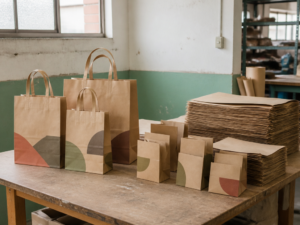
The last row concerns bag printing. Information such as manufacturing date and batch number requires reserved space on the layout, and print color affects price: the number of colors, print area, number of plates, and production quantity all affect plate-making and printing costs. Chia Huang can recommend a printing layout based on your budget and needs, balancing brand presentation with cost.
Receiving and Inventory: Easy Checks to Perform
Pulling the above sources together, day-to-day management of cement shelf life can be summarized into a few easy-to-follow actions: at receiving, check the manufacturing date and batch number on the bag, and visually inspect for any tears or water stains; when stocking, raise bags on pallets and arrange them in order of arrival so the earliest stock goes out first; periodically change storage positions, especially for the bottom layer; and before use, open bags for spot checks to confirm the cement flows freely. Most of these actions come from the specifications and PCA guidance cited above; the visual inspection for bag damage and water stains is our own addition based on storage logic.
If you're responsible for purchasing bags, there's one more thing worth doing: tell your supplier about your storage conditions. Expected storage duration, storage type (indoor, under a shed, or outdoors), whether it spans a humid season, how many layers pallets are stacked, and whether it's for export or long-distance transport — all of this information determines whether lamination is needed, how many plies to use, and how to weigh micro-perforation against moisture protection. For more complete cement bag specifications and customization options, see the Cement & Building Material Packaging page.
Cement Storage Shelf Life: Frequently Asked Questions
How long is the cement storage shelf life?
Among the resources we reviewed, there is no fixed shelf life that applies to all cement. PCA states that cement kept dry can maintain its quality over the long term, while moisture exposure slows setting and reduces strength; the Taoyuan City Government's construction specification Chapter 03052 states that bagged cement delivered after being stored in a local warehouse for a full 3 months may be retested — that's a retesting checkpoint, not an expiry date.
Can caked cement still be used?
For warehouse pack that develops after long-term storage, PCA states it can usually be corrected by rolling the bag, but when lumps don't crumble easily, important projects should run tests before use; Taoyuan's construction specification states that cement with moisture caking or hardening must not be used under any circumstances, and Taipei's construction specification likewise states that caked or deteriorated cement must not be used. For construction use, always follow specifications and supervision requirements.
What is the maximum number of bags of bagged cement that can be stacked?
Taoyuan's construction specification sets a principle of stacking no higher than 10 bags, while Taipei's construction specification requires stacking no higher than 10 bags, with at least about 20 cm clearance from the ground and first-in-first-out use. Actual stacking height should still be adjusted according to your site's specifications and stacking stability.
Can laminated coating on cement bags extend shelf life?
Lamination forms a physical waterproof barrier on the bag surface, reducing the risk of moisture exposure, but it is not a guarantee of shelf life — storage environment and duration remain the main factors. Whether to apply lamination should be assessed based on storage humidity and moisture sensitivity; for the principles involved, see Functional Treatments.
Should the manufacturing date be printed on the cement bag? Does print color affect the price?
Taipei's construction specification requires that, when supplied in bags, the bag must indicate the manufacturer's name, cement type, weight per bag, and manufacturing date. Print color affects price — the number of colors, print area, number of plates, and quantity all affect plate-making and printing costs. Chia Huang can recommend a printing layout based on budget and needs, balancing brand presentation with cost.
Conclusion: The Answer to Cement Storage Shelf Life Lies in Dryness and Management
Coming back to the original question, cement shelf life isn't a one-size-fits-all number. A dry environment, ground clearance and stacking height rules, and first-in-first-out rotation are what keep cement in good condition, while a bag's moisture-resistant and anti-slip design adds a further layer of protection on top of these practices. If you're evaluating cement bags, feel free to reach out via Contact Us and tell us your expected storage duration, storage type, pallet stacking height, and transport conditions — our sales team will respond within one business day with specification recommendations based on these factors.