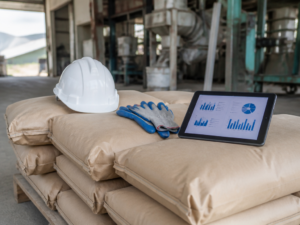
The challenge with packaging chemical materials often isn't the weight, but the nature of the contents: fine powder can leak out through the needle holes in the stitching, moisture-absorbing materials can cake up once they get damp, and bags can even burst from air pressure when filling speeds pick up. We at Chia Huang Paper have been making industrial paper bags since 1973. This article, written from a manufacturing perspective, covers four common issues in chemical material packaging and how bags can be designed to address them.
Let's first clarify the scope: every chemical material has very different properties, so which materials are suitable for paper bags, what needs to be labeled on the bag, and what transport regulations apply all need to be confirmed separately by the shipper based on their own product. What we can do is work with the conditions of your contents to reduce the risks of dust, moisture, and leakage to a reasonable level through the bag's structure, processing, and sealing.
Four Common Issues in Chemical Material Packaging
Chia Huang's chemical bags are suitable for contents including chemical powders, resin pellets, additives, and moisture-absorbing materials like anhydrous calcium chloride. They may all look like they're simply "put into a bag," but each requires a different design. We work backward from what could go wrong on site to determine how the bag should be made. The table below summarizes four typical issues.
| FAQ | Common Causes | Corresponding Bag Design | Key Information to Provide When Requesting a Quote |
|---|---|---|---|
| Powder Dust Leakage | Fine powder escapes from seam pinholes, valve openings, or filling ports | Heat-seal OverTape; microporous air vents assessed based on filling speed | Powder particle size |
| Moisture Absorption and Caking | Contents absorb moisture, or storage environment causes condensation | PE/PP coating; multi-layer structure | Moisture absorption level and storage conditions |
| Bag Rupture from Filling Pressure | Air pressure inside bag rises rapidly during high-speed filling | Micro-Pore Venting | Filling Machine Type and Speed |
| Heavy Load Bag Tear | Large bag weight causes bag body or seal to tear | Long-fiber kraft paper; number of layers designed based on weight | Bag Load Weight |
These four issues can occur at the same time—for example, a moisture-absorbing fine powder is vulnerable to both dampness and leakage. So instead of starting by asking "how many layers do you need," we first ask about the form of the contents, the degree of moisture absorption, and what equipment is used for filling, before deciding which processing options are worth adding.
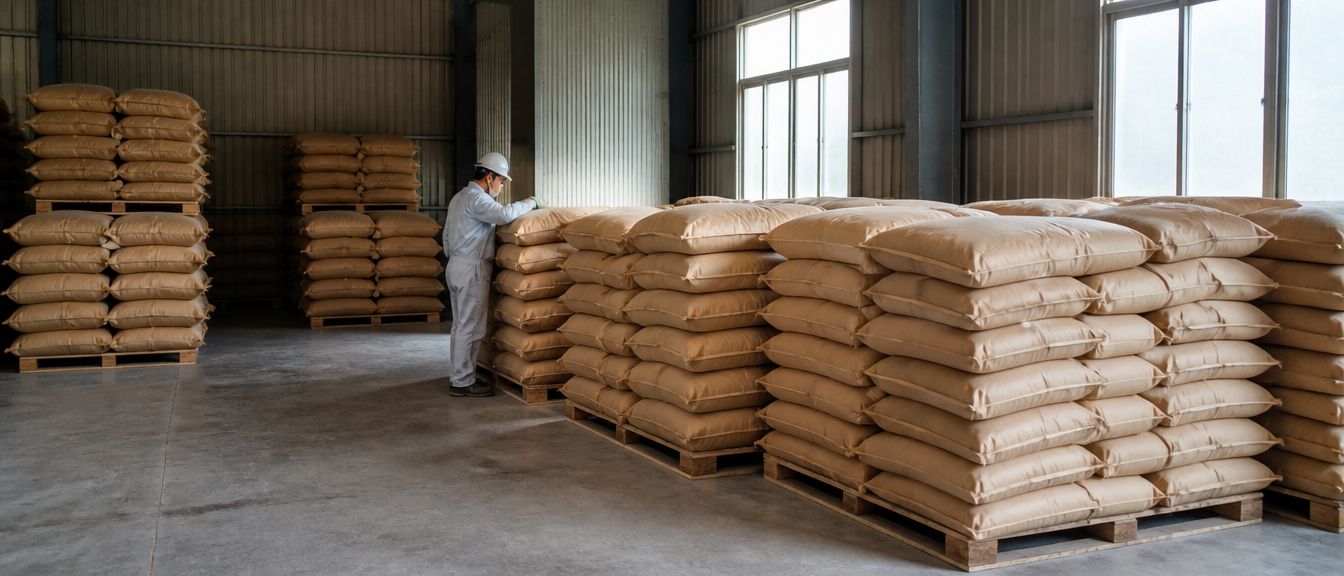
Filling and Air Venting: Microporous Holes—A Trade-off, Not More is Better
Dust can escape from several different points, with filling being just one of them. The European Federation of Multiwall Paper Sack Manufacturers (EUROSAC) and the Confederation of European Paper Industries' kraft paper producers group (CEPI Eurokraft), in their guide "Industry Guidelines: Dust-free paper sacks," list the main sources of dust leakage: the fit between the valve opening and the filling spout, the drop height when unloading bags, whether the bag size matches the fill quantity, bag corners, and perforations. This guide covers cement and similar construction materials, and notes that other powders should be confirmed with the bag manufacturer (see EUROSAC Dust-free Paper Sacks Guidelines), so the table below simply borrows its inspection perspective to look at chemical materials—it is not a specification for chemical bags.
| Points Where Powder Dust Can Escape | Guide Explanations | Questions to Ask When Selecting Bags |
|---|---|---|
| Valve Opening and Filling Nozzle | Their fit affects whether dust escapes during filling | Does the filling machine type match the valve opening size |
| Bag Size and Filling Quantity | Too loose causes poor stacking and possible valve leakage; too tight causes slow filling and potential small tears | Bag Weight and Powder Fluffiness |
| Drop Height and Bag Corners | Both drop height and bag corners can be sources of dust | Conveying and dropping method after filling |
| Perforation | Perforation reduces bag strength and causes dust leakage | Whether to add air vents depends on filling speed assessment |
The last row may seem to contradict our approach of providing micro-perforation venting, but it's actually two sides of the same trade-off. The guide recommends using high-permeability paper without perforations for cement bags, since perforations weaken strength and increase dust. Chia Huang approaches this from the process side: during high-speed automatic filling, if the air inside the bag has nowhere to go, the bag can easily burst or filling can become unstable. So for this type of production line, we recommend adding micro-perforation venting, with the hole size designed to let air escape without letting powder leak out. For manual filling or slower equipment, we assess and decide case by case. More micro-perforations isn't always better—it depends on the filling speed and powder fineness. If your powder is especially fine, please let us know when requesting a quote.
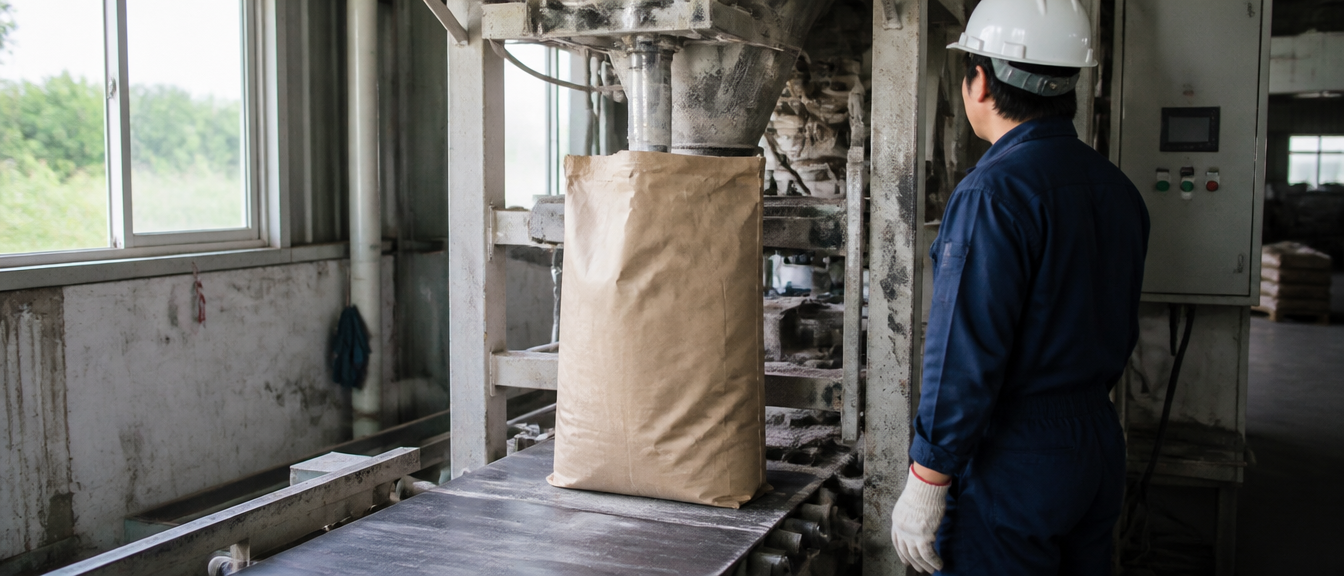
Sealing: Pinholes leak powder; OverTape seals cover the seam
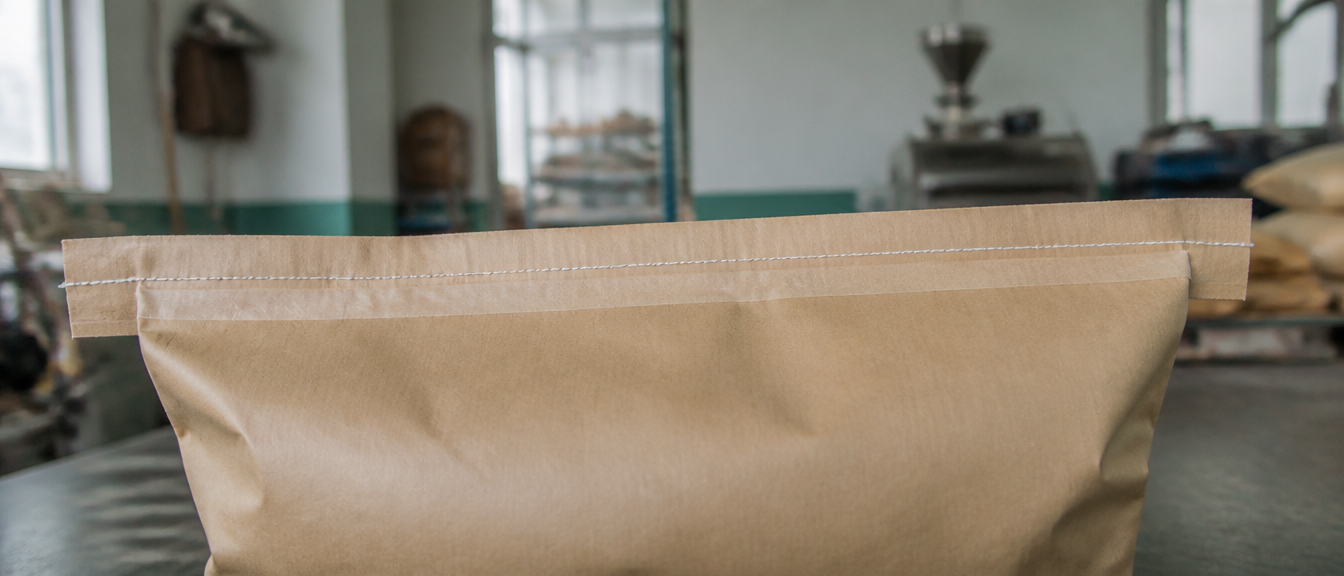
Stitching is the most common sealing method for heavy-duty packaging and offers high strength, but the sewing needle leaves pinholes at the bag opening, through which very fine powder can escape. For this type of content, we recommend switching to heat-sealed OverTape—sealing an additional strip of tape over the stitching to cover the pinholes and prevent fine powder from leaking out. The two methods can also be combined: stitching first to ensure strength, then adding OverTape for extra sealing. As a general guide: use stitching for standard heavy-duty packaging; use OverTape when the contents are fine powder that must not leak; and combine both when strength and sealing are equally important.
Bag Weight and Stacking: Coordinating Layer Count and Anti-slip Agents
In terms of layers, Chia Huang's paper bags use a 1-to-5-ply long-fiber kraft paper structure. Common practice is that plain kraft paper 25 kg bags typically use 3 plies, 40 kg bags typically use 4 plies, while switching to a tri-laminate kraft paper composite material typically reduces this to 2 plies. This is just a starting point—chemical materials vary widely in density and form, so the final specification still needs to be adjusted based on filling, transport, and stacking conditions. More layers isn't always better.
Stacking also needs to be considered together. When pallets are stacked high and transported over long distances, bags with surfaces that are too slippery are prone to shifting and collapsing, so anti-slip agents can be used to increase friction between bags. EUROSAC's guidelines also note that bags should not extend beyond the edge of the pallet, so how the bag size matches the pallet needs to be confirmed at the design stage.
Moisture Resistance and Leak Prevention: Coating Depends on Content Moisture Absorption Level
Another long-standing issue with chemical materials is moisture. Chia Huang's paper bags can be laminated for leak protection, with a layer of PE or PP plastic film coated on the bag surface to form a physical barrier that reduces the chance of outside moisture getting in—particularly helpful for materials that are highly moisture-absorbing or prone to leakage concerns. Lamination thickness can be adjusted as needed, and we assess whether PE or PP is more suitable based on the contents. Two points to note: lamination blocks moisture from outside the bag, but cannot block moisture that the material itself already contains; and lamination is a single-layer process, separate from the bag's 1-to-5-ply paper structure. The principles behind each type of processing are summarized in Functional Processing.
| Content Type | Primary Concern | Our Initial Assessment Direction |
|---|---|---|
| Hygroscopic materials, such as anhydrous calcium chloride | Moisture Absorption and Caking | Coating prioritized; thickness adjusted per requirements |
| Fine powder | Powder Dust Leakage | Heat-seal OverTape, and assess microporous air vents |
| Granular materials such as resin pellets | Weight and handling | Layer count designed based on weight; whether to coat depends on storage conditions |
Bag Labeling and Printing: Confirm Regulations First, Then Discuss Layout
If the chemical material is classified as a hazardous chemical, the container must be labeled in accordance with the "Regulations for Labeling and Hazard Communication of Hazardous Chemicals." According to the National Laws & Regulations Database, Article 3 defines containers as including bags; Article 5 requires labeling with a pictogram, name, hazardous ingredients, signal word, hazard warning statement, precautionary measures, as well as the name, address, and phone number of the manufacturer, importer, or supplier, primarily in Chinese; Article 7 specifies that the pictogram must be a square tilted at 45 degrees, with a white background, black symbol, and a red border sufficient for warning purposes; Article 11 requires the manufacturer, importer, or supplier to label the container before providing it to a business entity or self-employed operator (see National Laws & Regulations Database). These are compliance responsibilities on the shipper's side, and the content should be based on the version confirmed by the shipper. The regulations have recently been amended, with some appendices applying from January 1, 2029 (Republic of China year 118); please check the latest provisions before finalizing the print version.
Chia Huang offers four-color printing, and branding, specification information, and labeling content confirmed by the shipper can be planned for printing on the bag surface, completed before processing. Please provide your design file; we can provide an electronic layout file and use a similar bag style as a sample reference, then proceed to formal production after confirmation. The pictogram requires a white background, red border, and black symbol—whether to print it directly on the kraft-colored bag surface or handle it separately as a label is best confirmed with the shipper's regulatory contact in advance. Printing colors also affect pricing—the number of colors, printing area, number of plates, and production quantity all affect plate-making and printing costs. Chia Huang can recommend a printing configuration that balances brand presentation and cost based on your budget and product needs. Whether printing directly or using labels, we recommend checking the pictogram, ingredient names, and supplier information all at once when confirming the layout, to avoid discovering insufficient space after the bags have already been printed.
Before requesting a quote, prepare these items
The more complete the information, the more accurate our specification recommendations can be. We suggest preparing five things in advance: the name and form of the contents, including whether it's powder or granular, fineness, and degree of moisture absorption; bag weight; filling equipment, whether automatic or manual, and filling speed; storage and transport conditions; and printing requirements and labeling content. The minimum order quantity for customized production is about 5,000 bags. For a brand-new design requiring plate-making, if cumulative annual orders reach 50,000 bags, the plate-making fee can be deducted from the order amount.
Each of these items serves a specific purpose: the form and moisture absorption of the contents determine whether lamination is needed and how to choose the sealing method; the type and speed of filling equipment determine whether micro-perforation venting is needed; the bag weight and stacking method determine the number of layers and anti-slip agent use; and storage and transport conditions affect the lamination thickness. If any one item is missing, we can still offer general direction, but the final specification can only be confirmed once all the information is provided.
Common Questions About Chemical Material Packaging
What chemical materials can be packed in chemical bags?
Common materials include chemical powders, resin pellets, additives, and moisture-absorbing materials like anhydrous calcium chloride. Whether a material can actually be packaged this way and how it should be designed requires you to provide details about the contents for our assessment. For regulations and transport requirements related to hazardous materials, please confirm separately on your end.
Must chemical material packaging always have a coating?
Not necessarily. Whether lamination is needed depends on the moisture absorption of the contents and the storage environment. Chia Huang's paper bags can be laminated for leak protection, with a choice of PE or PP, and thickness adjusted as needed. Lamination is a single-layer process, separate from the bag's 1-to-5-ply paper structure.
What should we do if fine powder leaks from seam pinholes?
We recommend switching to heat-sealed OverTape, adding a sealing strip over the stitching to cover the pinholes and prevent fine powder from leaking out. Stitching combined with OverTape can also be used together to balance strength and sealing. Please specify the fineness of the powder when requesting a quote.
Are microporous air vents always necessary on chemical bags?
For high-speed automatic filling lines, we recommend adding micro-perforation venting to let air escape without letting powder leak out. For manual filling or slower equipment, we assess case by case. If the powder is especially fine, please let us know in advance so we can work together on the venting design.
Can chemical bags be printed? Does print color affect the price?
Yes, Chia Huang offers four-color printing, which can include branding, specification information, and labeling content confirmed by the shipper. Printing color affects pricing—the number of printing colors, printing area, number of plates, and production quantity all affect cost. We can recommend a suitable printing configuration based on your budget and product needs.
What are the minimum order quantity and plate fees for chemical bags?
The minimum order quantity for customized production is about 5,000 bags. For a brand-new design requiring plate-making, if cumulative annual orders reach 50,000 bags, the plate-making fee can be deducted from the order amount. The number of printing colors and plates affects plate-making costs—please describe your design requirements when requesting a quote, and we'll assess it together.
Conclusion: Chemical Material Packaging, Starting from the Properties of Contents
There's no one-size-fits-all answer for chemical material packaging: even among powders, fine powder needs sealing attention, moisture-absorbing materials need lamination attention, and high-speed filling needs venting attention. Once the contents, weight, filling equipment, and storage conditions are clearly specified, the structure, processing, and sealing method can be properly determined. If you're already using a particular bag, feel free to describe the issues you're experiencing directly—such as powder leakage, caking, or bags bursting during filling—and we'll work backward from the problem to determine which design element needs adjusting. To see the full range of applications first, check out the Chemical Material Packaging page; once you've prepared the information above, feel free to reach out via Contact Us, and our sales team will respond within one business day.