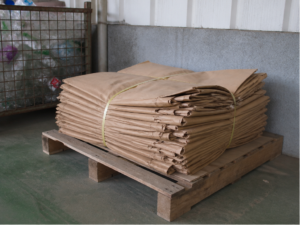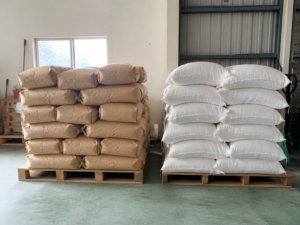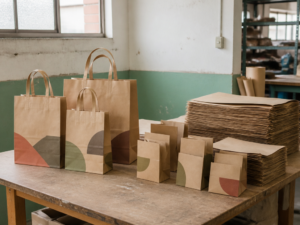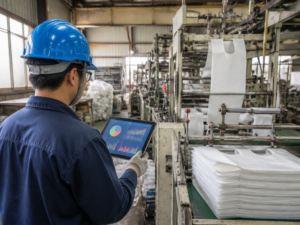
The term "custom paper bags" actually covers two very different needs: one is the handheld paper bags used by retail stores, and the other is industrial heavy-duty paper bags used for cement, chemical powders, feed and fertilizer. This article is about the latter. The summary of international standard ISO 6590-1:2025 explains that this paper bag terminology standard covers single-layer and multi-layer paper bags, as well as paper-based bags combined with other materials, and explicitly excludes retail bags (see the standard description page on the ISO website). The industrial paper bags Jia Huang Paper has manufactured since 1973 fall into this category.
Ordering custom paper bags isn't as simple as placing an order — it involves a series of considerations you need to think through first: what the bag will contain, how it will be filled, where it will be stored, what will be printed on it, and the two key thresholds of minimum order quantity (MOQ) and plate fees. This article walks through, in order, the questions to answer before customizing, how to think about MOQ and plate fees, why print colors on custom paper bags affect pricing, the process from inquiry to shipment, and the information you should prepare before requesting a quote.
Custom Paper Bag Ordering: Six Key Questions That Determine Your Bag's Design
The specifications of an industrial paper bag are not picked from a size chart — they're worked out backward from the actual use case. According to Chia Huang Paper's inquiry guidelines, our sales team needs information on the contents' characteristics, weight, specification requirements or sample drawings to provide a quote; the inquiry form asks you to describe the contents, specifications, quantity, purpose and conditions of use. Organizing these answers into the table below shows how each one affects a different aspect of the bag's design.
| Questions to Answer | Design Impact | Customization Options Available at Chia Huang Paper |
|---|---|---|
| Contents and Weight per Bag | Number of Plies and Paper Material | Paper bags have 1 to 5 layers; plain kraft paper is commonly 3 layers for 25 kg and 4 layers for 40 kg, while three-ply kraft paper composite materials are usually 2 layers |
| Filling Method | Bag Type and Venting | High-speed automatic filling recommends adding micro-perforations for venting; manual filling can be evaluated |
| Storage Location and Duration | Moisture Protection Design | PE coating, PP coating, or woven fabric coating |
| Pallet Stacking Height and Shipping Distance | Bag Surface Friction and Sealing | Anti-slip agent; stitching, heat sealing with OverTape, or stitching with OverTape |
| Bag Surface Printing Design | Plate Making and Printing | 4-Color Printing |
| Order Quantity | Minimum Order Quantity and Plate Fees | Customized minimum order quantity: approximately 5,000 bags |
One note on layer count: the figures in the table reflect common practice, not a fixed formula. The actual number of layers still needs to be designed around the packaging weight, material structure, product characteristics, filling method, and transport and stacking conditions. Film lamination is a separate matter — it's a single-layer process, distinct from the 1-to-5-layer paper structure, and shouldn't be confused with it. For guidance on how many layers to start with for different weights and use cases, see our structure and customization notes on multi-wall kraft paper bags.
Minimum Order Quantity and Plate Fees: Two Thresholds for Custom Paper Bag Ordering
The MOQ for custom production is approximately 5,000 bags. For a new product whose specifications haven't been finalized, this quantity serves to validate a new size or processing method before committing to a larger volume.
Plate fees are the second hurdle. A completely new design requires a plate, and the plate fee depends on the complexity of the design; under Chia Huang Paper's policy, once cumulative annual orders reach 50,000 bags, the plate fee can be deducted from the order value. In other words, whether the plate fee can be offset depends on your cumulative order volume within the year. So when planning your first order, it's worth considering the plate fee alongside your estimated annual volume, rather than looking at a single quote in isolation.
Two numbers here are easy to confuse: approximately 5,000 bags is the MOQ for custom production, while 50,000 bags is the annual cumulative threshold for the plate fee offset. The former determines whether you can get started; the latter determines whether the plate fee can be deducted from the order amount. If your estimated annual volume falls between the two, we recommend sharing your full-year estimate and phased ordering plan directly with the sales team when requesting a quote, so the quote and plate fee offset can both be confirmed at once.
Lead time likewise has no fixed number of days. According to the website, lead time depends on order volume, whether a new plate needs to be made, and the production schedule at the time; the sales team will inform you of the specific achievable lead time before you place the order. For urgent orders, please note this in your remarks so it can be assessed for priority scheduling. The table below groups items related to cost and timeline together, for easy reference before requesting a quote.
| Item | How Chia Huang Paper Does It | Information to Provide When Requesting a Quote |
|---|---|---|
| Minimum Order Quantity | Customized orders start from approximately 5,000 bags | Anticipated order quantity and annual usage |
| Plate Fee | New designs require plate making; if annual cumulative orders reach 50,000 bags, the plate fee can be deducted from the order amount | Whether it's a brand new design, design complexity, and estimated annual quantity |
| Printing | Number of colors, printing area, number of plates, and quantity all affect plate making and printing costs | Number of brand colors and printing area needed |
| Delivery Time | Depends on order volume, whether new plate making is required, and production line scheduling | Expected delivery date and whether it's urgent |
The plate fee and printing rows in the table are related: both depend on the design, so the earlier the design is finalized, the more complete the cost picture will be at the quoting stage.
Custom Paper Bag Printing: How Color Affects Price
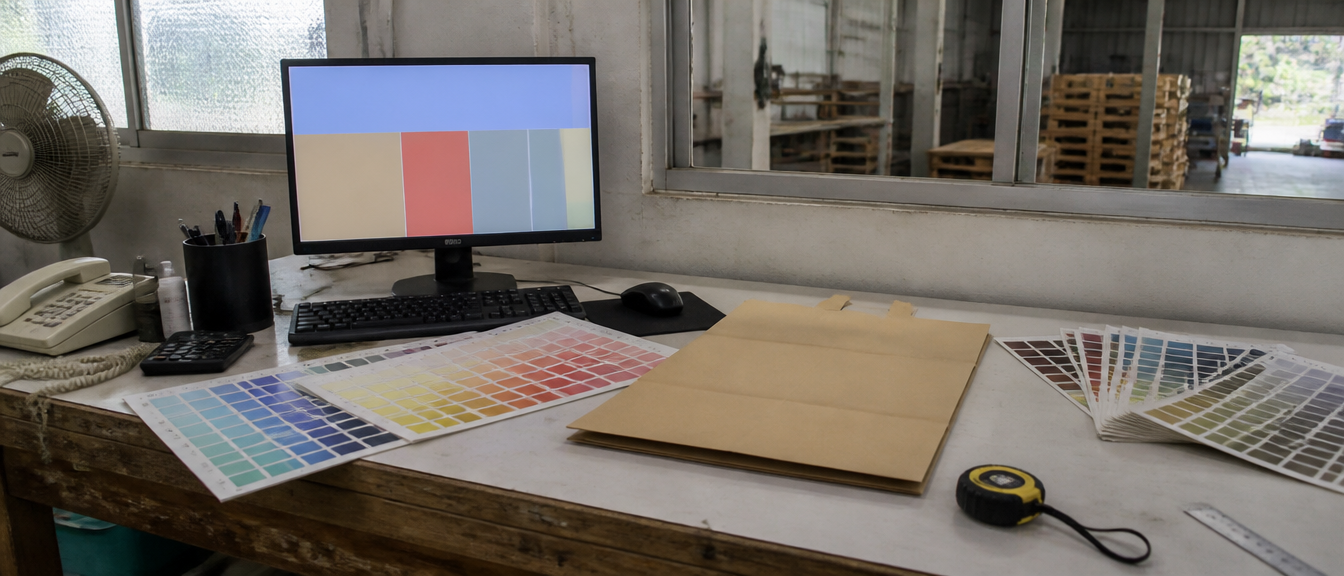
Chia Huang Paper uses four-color printing on its paper bags, allowing for brand logos, patterns and multi-color designs, and follows a print-first, bag-and-finish-later process so the printed surface is protected during later processing and shielded from abrasion. As for how many colors and how large an area a design covers, that goes straight into the price. This is the first thing to understand about custom paper bags: printing color affects price. The number of colors, printed area, number of plates and production quantity all affect plate-making and printing costs — generally speaking, the more colors, the higher the cost.
This doesn't mean the design has to be stripped down to the bare minimum. Our approach is to recommend a suitable printing configuration based on your budget and needs, balancing brand presentation with cost. From a plate-making perspective, it helps to split the bag surface content into two categories: information that must be identified by color, such as the primary brand visual, and information that only needs to be legible, such as specification and weight text. Whether the latter can share the same color as the primary visual is worth discussing when requesting a quote. For more on the printing process and details, see the Printing Technology page.
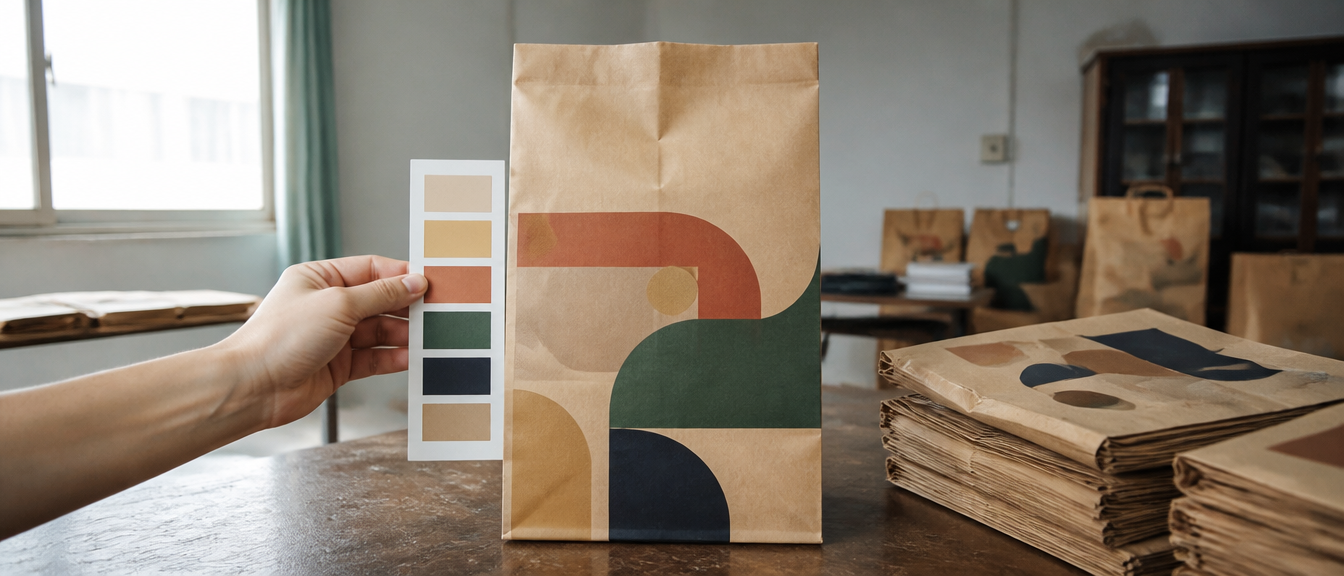
The process from design file to finished product works like this: you provide your brand's design file and color specifications, and Chia Huang Paper can supply an electronic proof of the print layout along with a similar bag style as a sample reference; once confirmed, we move on to formal printing and bag-making. The purpose of this step is to ensure the finished product matches your brand visuals, avoiding the discovery of color discrepancies only after the whole batch is complete.
Besides the brand, the bag surface may also need space reserved for regulatory labeling. Take the Ministry of Labor's "Regulations of Hazard Communication for Hazardous Chemicals" as an example: the regulation includes "bags" within its definition of "containers." Before supplying hazardous chemicals to a business entity, the manufacturer, importer or supplier must label the container with a hazard pictogram, product name, hazardous ingredients, signal word, hazard warning statement, precautionary measures, and the name, address and phone number of the manufacturer, importer or supplier, with text primarily in Chinese. The pictogram must be a square rotated 45 degrees (diamond orientation), using a black symbol, white background and red border (see the full regulation text on the National Laws & Regulations Database). As queried on the National Laws & Regulations Database in October of the 115th year of the Republic of China (2026), this version of the regulation was last amended on August 26 of the 115th year, with some appendices taking effect January 1 of the 118th year. Whether this regulation applies, and what content must be labeled, is determined by the supplier of the contents and the relevant authority — Chia Huang Paper does not determine regulatory applicability on the customer's behalf. However, reserving layout space for this during the bag design stage can prevent discovering, after printing, that there's no room left.
From Quote to Shipment: Custom Paper Bag Development Process
Based on the explanations across Chia Huang Paper's website, the customization process can be organized into several stages. Stage one is the inquiry: reach out via email, phone or the online form with the contents' characteristics, weight, specification requirements or sample drawings, and our sales team will provide a quote accordingly, responding within one business day. Stage two is structural and processing recommendations: using the answers from the table above, we determine the number of layers, lamination, micro-perforation venting, anti-slip additives and sealing method, with Chia Huang Paper helping select the appropriate material structure based on use, filling method, and transport and stacking conditions. Stage three is print confirmation: if you have a design file, provide it along with color specifications to confirm the layout. Stage four covers plate-making, printing and bag fabrication for new designs, concluding with shipment according to the scheduled delivery date.
Each stage involves something that requires your input, so the sooner you have the information ready, the fewer rounds of back-and-forth communication will be needed. You can request a quote even without a design file: according to the website, providing the contents, weight, specifications or sample drawings is enough for a quote, and a design file can be provided later if needed.
Prepare This Checklist Before Requesting a Quote
To summarize, before requesting a quote, it's best to have the following ready: the name and characteristics of the contents, such as powder fineness and moisture sensitivity; weight per bag; filling equipment and speed; storage and transport conditions, including indoor or outdoor storage, pallet stacking height, and whether the product will be exported; bag surface design and expected number of print colors; and expected order quantity and desired delivery date. If your procurement process requires certification documents, you can request these at the same time: Chia Huang Paper is ISO 9001 certified for quality management, and can use FSC-certified raw materials and provide certification documents on request — simply ask your sales contact when documentation is needed for an audit, and it's usually available within one business day.
Here's a hypothetical example, for illustration only, not an actual case: "25 kg powder, high-speed automatic filling, warehouse in a humid region, pallets stacked 5 layers high, single-color logo and specification text printed on the bag surface, first batch approximately 5,000 bags, hoping to receive delivery by a certain date." This single statement already answers the main points of the six questions in the table above, allowing the sales team to directly assess the number of layers, lamination, micro-perforation and print configuration.
Some information may not yet be available at the time of inquiry, such as the number of print colors or storage duration — there's no need to wait until everything is finalized before reaching out. Just note your current assumptions and budget range, and our sales team can suggest an initial configuration, which can then be refined as details are confirmed. This is also how we recommend printing configurations and processing combinations based on budget and requirements.
If you'd like to learn more about our company background first, About Chia Huang Paper covers our company profile and history: founded in June 1973 in Shanhua, Tainan, with over 50 years in the industry.
Frequently Asked Questions About Custom Paper Bag Ordering
What is the minimum order quantity for custom paper bags?
Chia Huang Paper's minimum order quantity for custom production starts at around 5,000 bags. If you're looking to introduce a new size or processing method, this quantity is a good starting point to validate the specifications before committing to larger volumes.
How is the plate fee calculated for custom paper bags?
A brand-new design requires plate making, and the plate fee depends on the design's complexity. Once annual cumulative orders reach 50,000 bags, the plate fee can be offset against the order amount; for the actual amount, please provide the design file for the sales team to assess.
Does the printing color of custom paper bags affect the price?
Yes. Printing costs vary depending on the number of print colors, printed area, number of plates and production quantity — generally speaking, the more colors, the higher the plate-making and printing costs. Chia Huang Paper can recommend a suitable printing configuration based on your budget and requirements, balancing brand presentation with cost.
Can I request a quote without a design file?
Yes. Providing the contents' characteristics, weight, specification requirements or sample drawings allows our sales team to prepare a quote; if you have a design file, you can provide that as well, and Chia Huang Paper can supply an electronic print layout file and a similar bag style as a sample reference.
Can Chia Huang Paper Make Retail Handle Paper Bags?
Our core focus is industrial heavy-duty paper bags, such as cement bags, chemical bags, feed bags, powder bags, building material bags and sugar bags. If your needs are for retail use, please describe the intended use and specifications when requesting a quote, and our sales team will assess whether it falls within our capabilities.
How long does custom paper bag ordering take from quote to delivery?
There's no fixed number of days. Lead time depends on order volume, whether a new plate needs to be made, and the production schedule at the time. The sales team will inform you of the specific achievable lead time before you place the order — please note urgent orders in your remarks.
Conclusion: Custom Paper Bag Ordering Starts with Clarifying the Details
The key to ordering custom paper bags isn't picking an attractive size — it's clearly defining the contents, filling method, storage and transport, bag surface design and quantity, and then figuring out how MOQ and plate fees fit together. Once you have the information above ready, feel free to visit Contact Us to submit your inquiry, email jhpaper233@gmail.com, or call (06) 581-7111 Monday to Friday, 08:00–17:00. Our sales team will respond within one business day with specification recommendations and pricing guidance based on your requirements.