Kraft paper is brown — and that single fact changes everything you should expect from paper bag printing. The same brand red that looks vivid on white paper may appear duller on kraft paper; light colors can get overwhelmed by the brown base; and the more colors used, the higher the plate-making and printing costs. If you want to turn an industrial paper bag into a branding tool, these three factors need to be considered together.
This article explains the kraft paper bag printing process from a manufacturing perspective — from design file to bag-making — and why kraft paper printing colors differ from what you see on screen. It also breaks down how color count, print area, number of plates, and quantity affect pricing, and wraps up with design trade-offs and quote preparation tips for limited budgets. Industry background references come from the paper bag industry association PSSMA and printing suppliers; details on Chia Huang's own practices follow the company's official pages.
Paper Bag Printing Process: From Design File to Bag Manufacturing
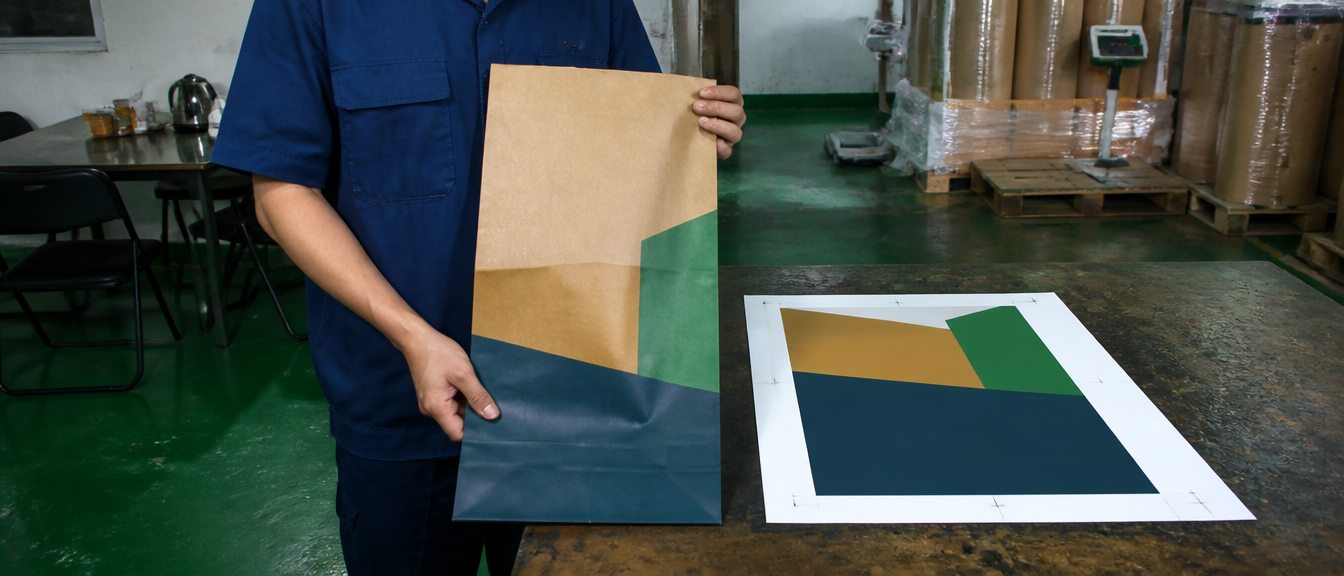
Chia Huang's kraft paper bag printing uses four-color printing, in four steps: providing the design file and color specifications, layout confirmation, formal printing, and bag-making. During layout confirmation, Chia Huang can provide an electronic file of the print layout along with similar bag styles as sample references, to confirm everything is correct before moving into formal printing and bag-making — the goal being to avoid discovering color discrepancies only after mass production.
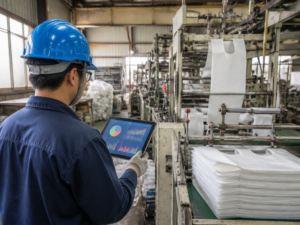
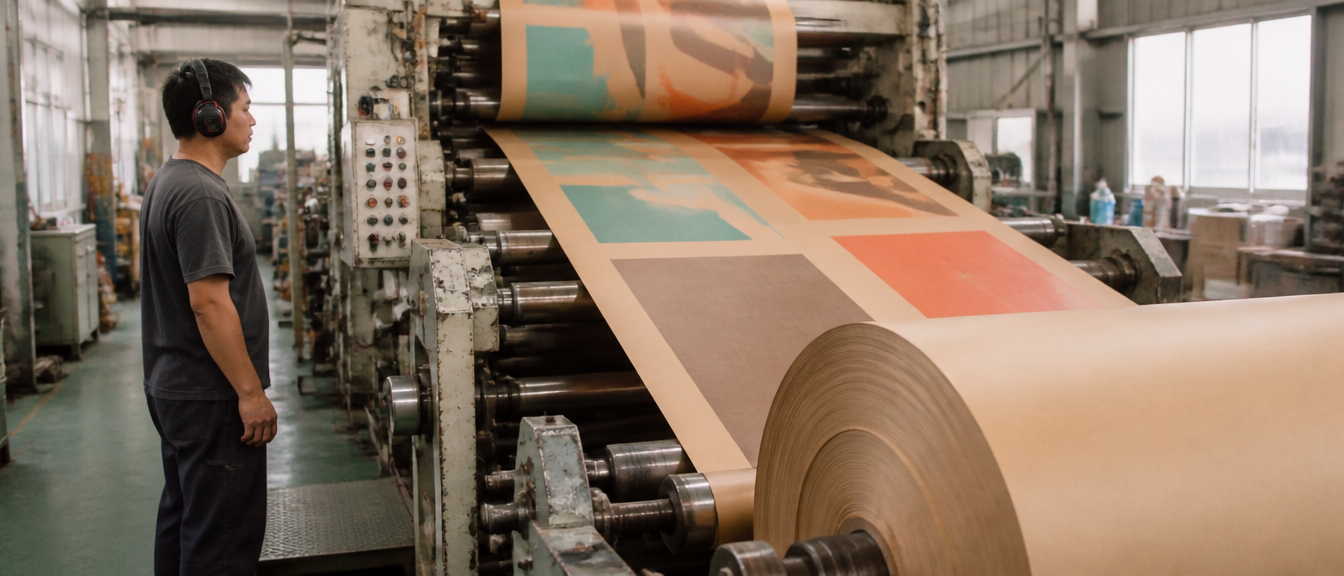
In terms of sequence, Chia Huang prints first and processes afterward: the printed surface is protected during subsequent bag-making, laminating, and other processing steps, making it less prone to wear or scratching, and keeping colors more durable. This aligns with common industry practice. The paper bag industry association PSSMA explains that before a paper bag is manufactured, the outer paper is typically printed first using a rotary printing press: the artwork film is transferred onto a plate, the plate is mounted on a printing cylinder, and the image is then transferred onto the paper.
| Process Steps | What You Need to Prepare or Confirm | Why It Matters |
|---|---|---|
| Provide Design File and Color Specifications | Brand logo, graphics, specified colors, and printing placement | The more complete your design file, the more accurately we can reproduce your brand visuals |
| Layout Approval | Review the printing layout digital file and reference samples of similar bag styles | Identify any layout and color issues before formal production begins |
| Formal Printing | Confirm number of colors, printing area, and production quantity | These factors affect platemaking and printing costs |
| Bag Manufacturing | Confirm any subsequent processing such as lamination and sewn sealing | Print first, then process—this protects the printed surface during manufacturing |
During layout confirmation, it's recommended to check several items one by one: whether all brand-specified colors appear in the layout, whether text and fine lines are clear, and whether the graphic placement on the bag surface is appropriate. Also note that stitching or seals at the bag opening may cover designs placed too close to the edge, so important information should be kept at a distance from the opening — the actual safe margin can be confirmed with sales based on the bag style.
PSSMA also notes that most paper bags today use flexographic printing: photopolymer plates combined with fast-drying, highly fluid solvent- or water-based inks, suited to high-speed, low-cost in-line printing. Note that Chia Huang's pages do not specify which type of printing press is used — the machinery discussed here is industry background only and does not represent Chia Huang's equipment. Printing occurs on the outer layer of the bag, while the other layers serve different functional roles, so printing cannot replace the design of the multi-layer structure — the two need to be planned together.
Kraft Paper Printing Colors: Why They Look Different on Screen
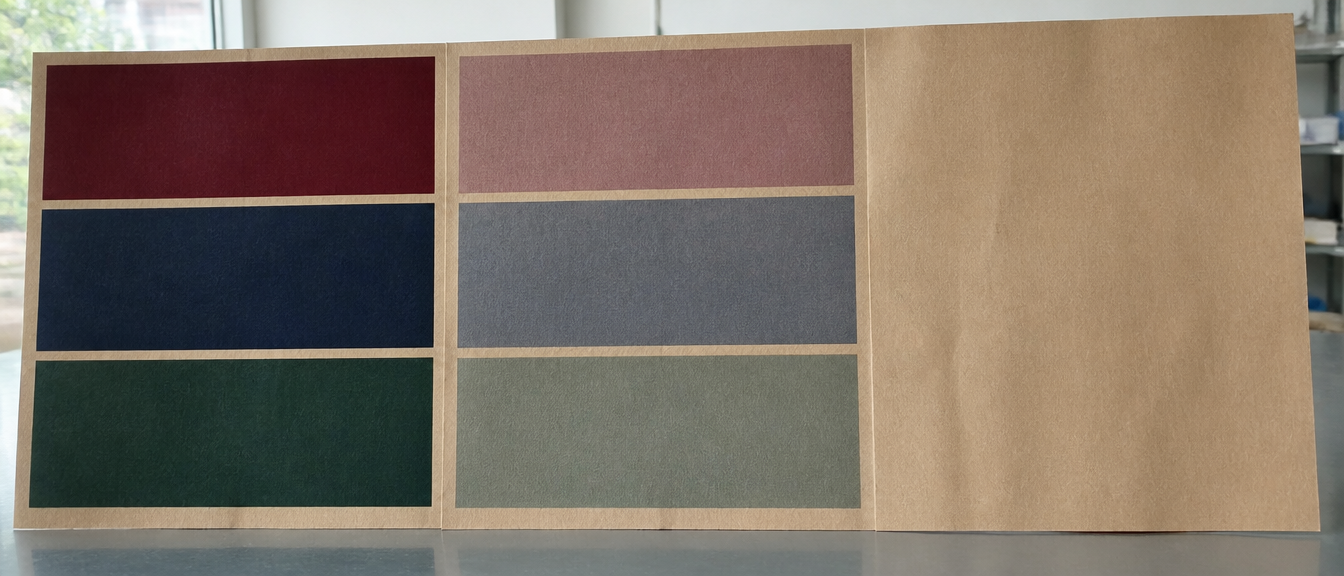
Brown kraft paper is made from unbleached pulp, and its color comes from the lignin retained in the pulp — there's no dye and no coating. The printing supplier 4OVER4 explains in its kraft paper printing guide: the inks used in four-color printing are semi-transparent, so every color printed on kraft paper is actually the result of the brown base showing through a layer of colored ink film. This means colors appear darker, warmer, and lower in contrast than when printed on white paper. That guide focuses on kraft paper cards, but we judge that the same principle of semi-transparent ink layered over brown paper also applies to kraft paper bags.
The same guide also points out: since there's no white ink in a four-color overprint process, white in the design file simply means "no printing," which on kraft paper reveals the kraft paper's own color. Deep, saturated colors retain their original clarity, while light-colored dot screens with coverage below about 30% tend to lose their hue, and highlights in photos tend to disappear. The guide also recommends simplifying designs — a two-color design on kraft paper often outperforms a four-color one. In addition, since the paper surface has no coating, ink tends to seep into the fibers and spread slightly, so fine lines appear somewhat thicker than in the design file, and dense dot patterns can easily blur together.
| Design Element | Common Appearance on Kraft Paper | Design Solution |
|---|---|---|
| Dark, saturated color blocks such as deep red, deep blue, deep green | Maintains readability but appears darker and warmer than on screen | Use as primary brand color; expect the final product to appear darker than on screen |
| Light colors, pastels, and low-coverage halftones | Easily obscured by the background color, becoming dull | Avoid as main colors, or use a deeper shade of the same color family |
| White text and white backgrounds | No white ink available; white areas reveal the natural kraft paper color | Use dark text printed on natural kraft paper; if white is essential, please consult with our sales team for feasible options |
| Photos and gradients | Highlights disappear, detail is reduced | Use large color blocks and simple graphics; have our team evaluate feasibility |
| Fine lines and small text | Ink seeps into fibers and spreads slightly | Choose fonts with consistent stroke weight and avoid very thin lines |
Chia Huang's printing technology page offers a similar view on photos and gradients: whether photos or fine gradients are suitable depends on the design content and the paper surface, and it's recommended to provide the design file for sales staff to confirm. In other words, kraft paper printing isn't incapable of handling complex designs — it just requires factoring in the base color's effect at the design stage, and confirming with similar bag-style samples rather than making adjustments only after the finished product comes out.
There's another point that's easy to overlook: the color of kraft paper itself isn't fixed. 4OVER4's guide notes that fiber source, recycled content, and production batch can all cause kraft paper's color to lean slightly lighter or grayer, and two batches of paper made months apart may show a noticeable difference when placed side by side. For brands that need to place repeat orders, this means the same design file printed on different paper batches may not match in color exactly. Our suggestion is to keep a sample of the previous batch's finished product as a reference when reordering, and to specify your tolerance for color variance when requesting a quote.
Number of Colors, Area, Plates, and Quantity: How Paper Bag Printing Costs Are Calculated
Does printing color affect price? Yes. According to Chia Huang, printing costs for packaging bags vary depending on the number of colors, print area, number of plates, and production quantity; generally speaking, more colors mean higher plate-making and printing costs.
PSSMA's data doesn't address price directly, but it offers a useful reference point: using a new eight-color flexographic printing press as an example, speed drops from 1,200 feet per minute for single-color printing to 500–800 feet per minute for full-color process printing, and can be operated by two people. This example shows that the same machine runs slower when printing a full-color process compared to single-color. This is just an illustrative example of machinery — Chia Huang's actual production conditions and quotes should still be confirmed with sales.
As for plate fees, new designs require plate-making, and the cost depends on the design's complexity. Chia Huang's custom minimum order quantity is about 5,000 units, with custom specifications adjustable by size, paper material, printing, and bag style to help reduce inventory pressure for new product development; once cumulative annual orders reach 50,000 units, plate fees can be deducted from the order amount.
| Factor | Impact | How to Adjust |
|---|---|---|
| Number of Print Colors | More colors increase platemaking and printing costs | Identify which colors are brand-essential; use natural kraft paper or the same color family for secondary elements |
| Printing Area | Printing area affects the cost | Focus on main visuals and minimize other areas |
| Number of Plates | Affects platemaking costs | Specify the design and quantity of each version when requesting a quote; our team will recommend the optimal printing layout |
| Production Quantity | Quantity affects printing costs | Cumulative annual orders of 50,000 units or more qualify for plate fee credits applied to the order total |
| Design Complexity | Platemaking costs depend on design complexity | Simplify graphics and reduce gradients and photos |
Why are plate fees and quantity often discussed together? PSSMA has summarized the pros and cons of common paper bag printing methods, which shows how the cost structure of plates affects quantity. It notes that flexographic printing is the most commonly used method for multi-layer paper bags, while rotogravure offers very high quality and batch consistency, but the engraving cost of the cylinders is extremely high.
| Printing Method | Advantages listed by PSSMA | Disadvantages listed by PSSMA |
|---|---|---|
| Flexographic Printing | Lower plate-making costs than rotogravure, quick changeover and easy cleaning, can print on different materials, accurate color registration | Anilox rollers wear and need replacement, high drying costs, batch consistency inferior to rotogravure |
| Rotogravure Printing | Relatively simple mechanical structure, high batch consistency, suitable for long runs and repeat orders | Engraving costs are extremely high; plate fees for short runs are very expensive unless the job will be repeated many times |
This comparison doesn't indicate which method Chia Huang uses — it simply illustrates a general principle: the higher the plate cost, the more it needs to be spread across quantity and repeat orders. In Chia Huang's explanation, plate fees and cumulative order quantity are discussed together. If you want to balance brand presentation with cost-effectiveness, Chia Huang can recommend a suitable printing configuration based on your budget and product needs, striking a balance between brand presentation and cost. It's best to start this discussion before the design is finalized, since once color count and print area are locked into the design file, adjusting them later becomes the most costly.
Design compromises when budget is limited: use kraft paper as the base color
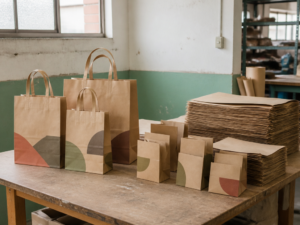
From a manufacturing standpoint, there are three trade-offs worth considering in advance. First, treat the kraft paper itself as part of the design: leaving areas unprinted to show the natural base color not only presents a natural material feel but also saves on print area. PSSMA notes that in the past, transport paper bags were mostly plain brown kraft paper with minimal or no graphics, whereas today's paper bags can also carry a product's brand image all the way to the point of sale.
Second, use color where it truly needs to stand out: use deep, saturated colors for the primary brand elements, and single colors or the natural kraft paper tone for secondary information. Third, don't forget the sides of the bag. PSSMA notes that in retail settings, paper bags are sometimes stacked flat and sometimes stood upright with one end facing the aisle to save space, which is why packaging designers often extend the design onto the sides of the bag. For products like animal feed and fertilizer that are moving toward retail and branding, the paper bag is the first impression on the shelf, making these trade-offs well worth careful attention. The above are suggestions based on manufacturing and printing logic — please confirm the actual configuration with sales.
Prepare this information before requesting a paper bag printing quote
When requesting a quote, it's recommended to provide details on the contents' characteristics and weight, bag style and specification requirements, design files and color specifications, as well as estimated quantity and budget range. If the design isn't finalized yet, you can also start by describing your brand colors, intended use, and budget, and sales will recommend a printing configuration based on your budget and needs. To get a sense of the process first, you can refer to Chia Huang's printing technology page.
It's also recommended to discuss how printing will be combined with other processing steps, such as whether lamination is needed or which sealing method will be used, since Chia Huang prints first and processes afterward — the printed surface still undergoes later-stage processing, so specifying the processing conditions in advance makes it easier to evaluate the printing configuration together.
Common questions about paper bag printing
How many colors can be printed on paper bags? Can photos or gradients be printed?
Chia Huang uses four-color printing, which can combine brand logos, graphics, and multi-color designs. Whether photos or fine gradients are suitable depends on the design content and paper surface — it's recommended to provide the design file for sales staff to confirm.
Does the number of printing colors affect the price?
Yes. Printing costs vary depending on the number of colors, print area, number of plates, and production quantity; generally speaking, more colors mean higher plate-making and printing costs. Chia Huang can recommend a suitable printing configuration based on your budget and needs, balancing brand presentation with cost.
How is the plate fee calculated for paper bag printing? Can it be credited?
New designs require plate-making, and the cost depends on the design's complexity. The custom minimum order quantity is about 5,000 units; once cumulative annual orders reach 50,000 units, plate fees can be deducted from the order amount.
Will the color of kraft paper printing differ from the design file?
Yes, there will be a difference. Kraft paper has a brown base, and semi-transparent ink printed on it generally appears darker and warmer than on white paper, with light colors most easily overwhelmed by the base color. Chia Huang can provide an electronic file of the print layout along with similar bag styles as sample references, and formal printing begins only after confirmation.
Why print before finishing?
Printing first and processing afterward protects the printed surface during subsequent bag-making, laminating, and other processing steps, preventing wear and scratches and keeping colors more durable and stable.
Conclusion: Paper bag printing is a balance between branding and cost
Paper bag printing isn't just about putting a design on the bag — it requires considering the kraft paper base color, color count, print area, and quantity together. Deep, saturated colors remain the most stable on kraft paper, while light colors and photos need careful evaluation; more colors also mean higher costs, so when budgets are limited, letting the kraft paper serve as the base color is a common and effective approach. If you're planning paper bag printing, feel free to share your design file, contents, and estimated quantity with us — visit Contact Us to submit your request, and our sales team will respond within one business day with a recommended printing configuration.