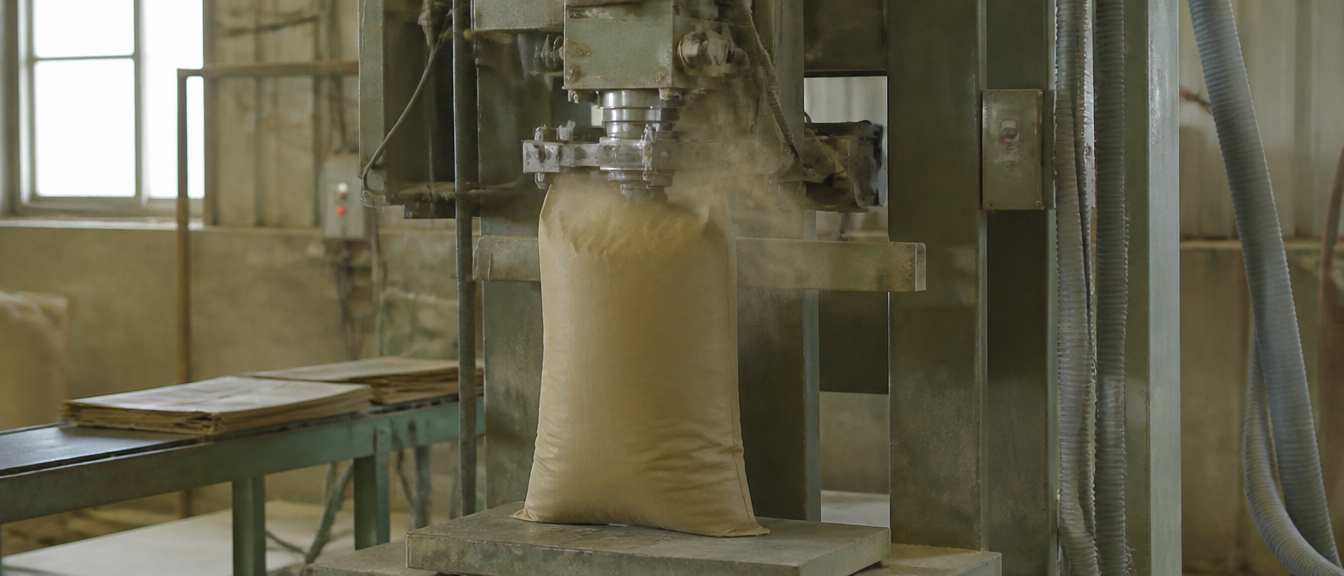
How fast a powder bag can be filled depends not just on the powder itself, but on whether the air inside can escape. When 25 kg of powder is pumped into a paper bag, the air that originally occupied the space inside the bag has to go somewhere: if it can't escape, the bag swells and, in severe cases, bursts; if it escapes too easily, it carries fine powder particles out with it, creating dust. Venting and dust control are really two sides of the same issue.
At Chia Huang Paper, we've been making industrial kraft paper bags since 1973. This article focuses on three things in powder bags and powder packaging that are most often lumped together: venting, dust control and sealing. The short answer first: micro-perforation venting is a solution for high-speed filling, not a standard feature for every powder bag. Whether to add it, and how to design the perforations, depends on how filling speed, powder fineness and bag material structure interact with each other.
Four On-Site Issues with Powder Packaging: Bag Bursting, Dust Emissions, Moisture Absorption, and Leakage
Packaging challenges for chemical powders are often greater than for ordinary powders. Some have high filling speeds, where air inside the bag can't escape fast enough and the bag bursts; some are very fine powders, prone to dust leakage through the pinholes left by sewn seams; some are moisture-sensitive and may even leak, requiring a tighter barrier. Each problem has a different root cause, and the bag design needed to address it differs accordingly. The table below maps these out.
| On-Site Issue | Root Cause | Corresponding Bag Design |
|---|---|---|
| Bag Bursting During High-Speed Filling | Air Inside Bag Cannot Be Expelled Quickly Enough | Micro-Pore Venting |
| Fine Powder Dust Leakage | Powder Particles Escape Through Stitching Needle Holes | Heat-Sealed OverTape to Cover Needle Holes |
| Moisture Absorption and Caking During Storage | Moisture Penetrates Into the Bag | PE or PP Coating, Selected Based on Moisture Sensitivity |
| Leakage of Hygroscopic or Semi-Liquid Materials | Insufficient Barrier Properties | Can Apply Coating to Prevent Leakage, Assessed Based on Material Characteristics |
Dust is not just a bag issue either. A U.S. Bureau of Mines research report from April 1985, "Bag Machine Dust Controls and Bag Sealing," carried out by Foster-Miller, Inc., identifies the sources of dust in powder bagging in concrete terms: during filling, excess air and product escape from the interface between the bag's valve and the filling spout; once the bag leaves the machine, dust blows out from the valve; and during conveying and handling, dust is further released from the valve and from powder-coated bag surfaces. The report's proposed solution is to improve clamp design to reduce spillage during filling, and to use a controlled vacuum system to remove excess air from the bag before it leaves the machine (see U.S. Bureau of Mines OFR 86-8 report).
This report is somewhat dated and addresses bagging machines at mining sites rather than the specifications of a particular bag type, but the logic it highlights aligns with venting design: the air inside a bag must be dealt with, and it must be dealt with without carrying powder away. Equipment-side solutions belong to the equipment side; the bag-side solution is venting design.
Micro-Pore Venting: Let Air Out, Keep Powder In
Micro-perforation venting involves designing tiny holes in the bag body so that air inside can escape immediately during high-speed filling, preventing the bag from swelling and bursting while also speeding up filling and stacking efficiency. The hole size is engineered with a specific goal: let air out while keeping the contents' particles in. So for high-speed automated filling lines handling powders and fine particles, we recommend adding micro-perforation venting; for manual filling or slower semi-automatic equipment, it can be evaluated case by case.
But micro-perforation venting isn't a free lunch. The "Dust-free paper sacks" guide (May 2016), compiled by the European Sack Group (a joint effort of CEPI Eurokraft and EUROSAC, two organizations in the kraft paper bag industry) and aimed at cement and similar construction materials, explicitly recommends using highly air-permeable, unperforated paper for cement bags, because perforation limits bag strength and causes dust. The guide measures paper air permeability using air resistance, in Gurley seconds, where a smaller number means higher permeability; it recommends paper of 5 to 7 Gurley seconds for standard cement bags. For applications requiring a very long shelf life—meaning the bag material needs a sealed film layer—the guide recommends using highly permeable paper for the inner layer and adding a venting system at the top or side of the bag (see EUROSAC's "Dust-free paper sacks" guide).
This guide also states that it covers cement and similar construction materials, and that for other powder products, bag manufacturers should be consulted separately for solutions. So we don't treat it as a specification standard for Chia Huang's bag types, but we do take from it the underlying trade-off: perforations let air escape, but they're also a weak point for strength and dust. The guide doesn't go into detail on the specific form of the venting system; from a manufacturing standpoint, as long as the bag material includes an air-impermeable lamination layer, air can't pass through the paper itself and needs a dedicated outlet—this is exactly the problem micro-perforation venting is designed to solve.
| Venting Method | How Air Escapes | Advantages | Points to Consider |
|---|---|---|---|
| High Breathability Paper, No Perforation | Escapes Through the Natural Pores in the Paper Itself | Strength Not Compromised by Perforation; Lower Risk of Dust Leakage from Holes | Must Select the Correct Breathability Level; If the Bag Material Has Coating Applied, Air Cannot Escape Through the Paper |
| Micro-Pore Venting | Escapes Through Micro-Sized Holes Designed on the Bag Body | Immediate Venting During High-Speed Automatic Filling, Preventing Bag Expansion and Bursting | Holes Affect Strength and Leakage Risk; Hole Size Must Be Designed Based on Powder Fineness; Fine Powders Require Prior Assessment |
| No Additional Venting Design | Relies on Slower Filling Speed to Allow Air to Naturally Dissipate | Simple Structure | Only Suitable for Manual Filling or Slower Equipment; Not Recommended for High-Speed Automatic Filling |
Our decision process works like this: first confirm the filling equipment and speed—high-speed automated filling should have venting built into the design from the start; next consider powder fineness—the finer the powder, the higher the risk of leakage, so hole size and placement need more careful evaluation; finally, consider whether moisture protection is needed—if so, the micro-perforations must be planned together with a moisture barrier layer, not venting alone.
Dust Control Goes Beyond the Bag: Filling Opening, Size, and Drop Height Matter
This guide actually lists a long range of dust sources, many of which are factors outside the bag itself. When filling valve bags, the valve must fit the filling spout without any gaps, otherwise air will carry dust out from underneath the spout; filling spouts with an inflatable sleeve are better suited to dust-free filling than tapered spouts. Bag size matters too: if the bag is much larger than its contents, the bag body goes slack, leading to poor stacking, and bag types with a self-closing valve may even leak powder; if the bag is too small, the bag body becomes overly taut, slowing down filling and potentially causing small tears during filling that release dust. In addition, the drop height from the filling point to the conveyor belt should be kept as short as possible, otherwise air and dust will escape before the valve fully closes.
Some of these factors are equipment-related, others relate to bag dimensions. We are the bag manufacturer, so equipment-side adjustments need to be evaluated together by the filling equipment supplier and the factory; what we can do is match bag dimensions, venting, sealing and moisture protection to your equipment conditions. So when requesting a quote, the type of filling machine, spout size and filling speed matter more than simply stating the weight in kilograms.
Powder Bag Sealing: Stitching Needle Holes and Heat-Sealed OverTape
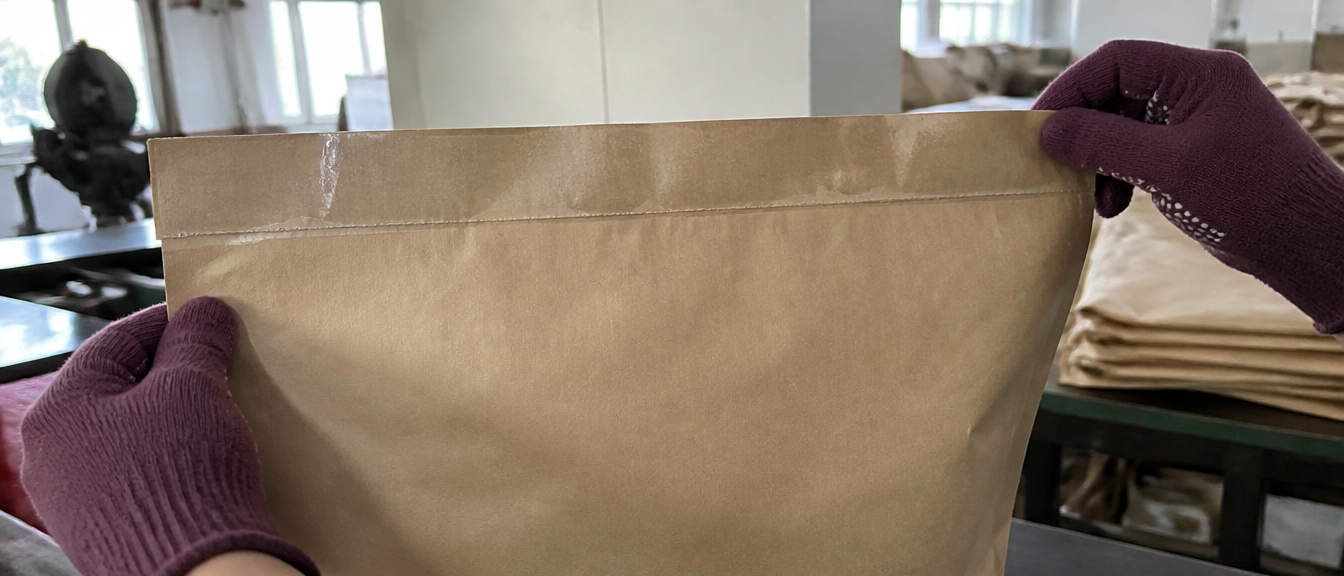
Another leak point to guard against in powder bags is the seal. Sewing is the most common sealing method for heavy-duty paper bags—sturdy and easy to open, suitable for most industrial contents. However, the pinholes from plain sewing may allow fine powder particles to leak out; for fine powder contents, we recommend heat-sealed OverTape, which adds a heat-sealed tape strip over the sewn seam to cover the pinholes and effectively prevent powder particles from escaping. The two methods can also be combined: sewing followed by OverTape, balancing strength and sealing.
| Closure Method | Strengths | Better Suited For |
|---|---|---|
| Stitching | Sturdy Structure and Easy Opening; The Most Common Choice | Granules, Coarser Powders, and Most Industrial Contents |
| Heat-Sealed OverTape | Covers Needle Holes to Prevent Particle Leakage | Fine Powder Chemicals and Powder Contents |
| Stitching + OverTape | Balances Sealing Strength and Seal Integrity | Fine Powders Requiring Both Strength and Leak Prevention |
The choice of sealing method should be considered together with venting. Venting is meant to let air escape; sealing is meant to keep powder in—both happen on the same bag and interact with each other, so they must be designed together. For fine powders combined with micro-perforation venting, we recommend evaluating heat-sealed OverTape at the same time, to avoid a situation where venting is handled well but powder still escapes through the sewing pinholes.
Powder Bag Moisture Protection, Stacking, and Printing
Chemical powders are also often moisture-sensitive. Chia Huang's moisture protection uses PE lamination or PP lamination, selected according to the moisture sensitivity of the contents; raw materials with strong hygroscopicity, such as anhydrous calcium chloride, or semi-liquid materials, require a tighter barrier and can use lamination to prevent leakage, with the actual solution evaluated based on the raw material's characteristics. One thing to note: lamination is a single additional layer, separate from the paper bag's 1-to-5-ply paper structure—ply count mainly governs load-bearing capacity, while lamination mainly governs moisture and leak protection.
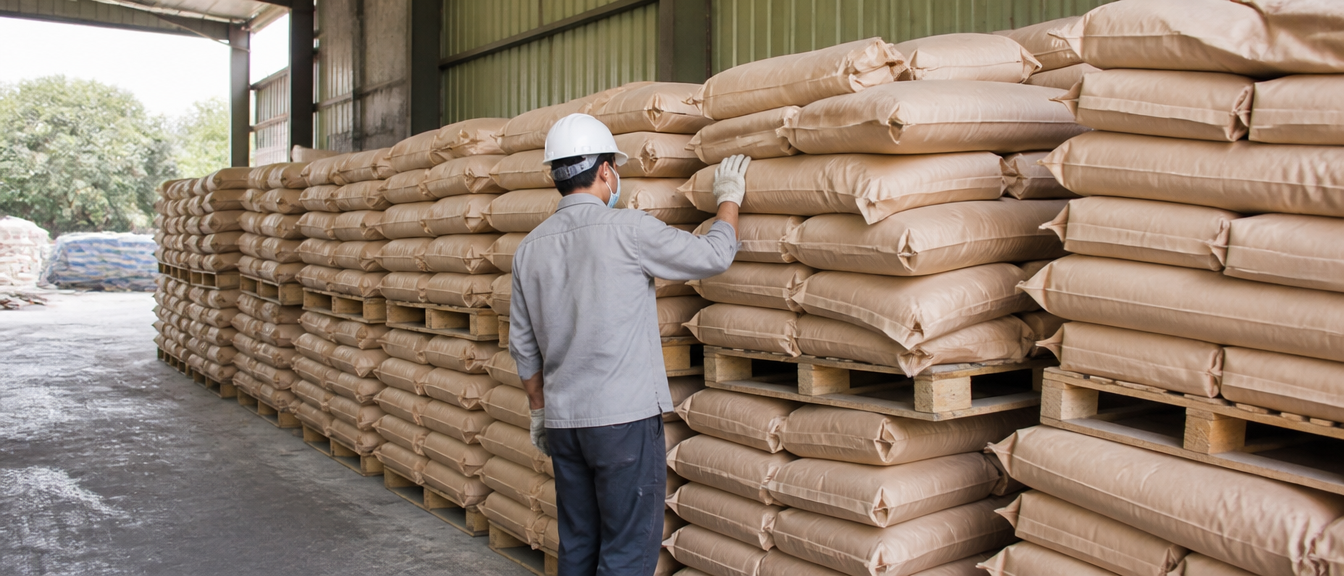
After filling, bags also need to be stacked on pallets. Micro-perforation venting reduces residual air inside the bag, making stacking more stable; adding an anti-slip coating to the bag surface increases friction between bags, making them less likely to slip and collapse when stacked high on pallets. Venting, moisture protection and anti-slip coating can all be combined on the same bag—the principles behind each treatment are summarized on the Functional Treatments page.
Chemical bags can be printed in up to four colors, allowing not just brand and specification information but also hazard labeling to be printed. Print color affects pricing: the number of colors, print area, number of plates and production quantity all influence plate-making and printing costs; Chia Huang can recommend a suitable printing configuration based on your budget and needs, balancing brand presentation with cost. A brand-new design requires plate-making; if cumulative orders reach 50,000 units within a year, the plate fee can be deducted from the order amount. The minimum order quantity for customized production is approximately 5,000 units. As for what content needs to be printed on hazard labels, please confirm this yourself according to the regulations applicable to you and your customers' requirements—we are responsible for printing the finalized content accurately.
Five Things to Prepare Before Requesting a Quote
The biggest risk in specifying powder bags is estimating with incomplete information. We recommend preparing the following in advance: first, the powder's characteristics, including fineness, flowability and moisture sensitivity; second, the filling method—automated filling line or manual filling, and the machine model and filling speed; third, the weight per bag, whether 25 kg or another specification; fourth, the storage and transport environment, including moisture exposure and how many layers of pallet stacking; fifth, printing requirements, including the number of colors and labels to be printed. With complete information, our sales team can determine in one pass whether micro-perforation venting is needed, whether sewing or OverTape should be used for sealing, and which type of lamination to choose. You can also check out the Chemical Raw Material Packaging page first to learn about common specification combinations for chemical bags.
Frequently Asked Questions About Powder Bags
Why Do Powder Bags Burst So Quickly During Filling? How Can This Be Solved?
Bag bursting is usually caused by air inside the bag not escaping fast enough. Micro-perforation venting can be added—tiny holes designed into the bag body let air escape immediately while keeping powder from leaking out. The exact hole size and placement should be evaluated based on filling speed and powder fineness; please provide these details when requesting a quote.
Will Powder Leak Out Through the Micro-Pore Venting Holes?
The size of the micro-perforations is engineered with a specific goal: let air escape while keeping particles in. However, the European cement bag guide notes that perforation limits bag strength and causes dust, so fine powder contents need prior evaluation; contents that also require moisture protection can be paired with a moisture barrier layer.
Do All Powder Bags Need Micro-Pore Venting?
Not necessarily. For customers using high-speed automated filling machines, we recommend adding micro-perforation venting; for manual filling or slower semi-automatic equipment, it can be evaluated case by case. The European cement bag industry guide even recommends using unperforated, highly air-permeable paper, so whether to add venting should be decided based on the filling method and bag material structure.
Can Fine Powder Leak Out Through the Stitching Needle Holes?
Pinholes from plain sewing alone may allow fine powder particles to leak out. For fine powder contents, we recommend heat-sealed OverTape, which adds a tape strip over the sewn seam to cover the pinholes. Please specify the powder's fineness when requesting a quote, and our sales team will recommend a suitable sealing method.
How Should Powder Bags Be Handled for Chemical Raw Materials That Are Moisture-Sensitive or May Leak?
Moisture protection can be achieved with PE lamination or PP lamination; for strongly hygroscopic or semi-liquid raw materials, lamination can also be used to prevent leakage, with the actual solution evaluated based on the raw material's characteristics. We recommend providing raw material information when requesting a quote, so our sales team can plan a suitable level of protection.
Can Hazard Labels Be Printed on Powder Bags? Does Print Color Affect Price?
Yes, chemical bags support four-color printing, which can include hazard labeling, brand information and specifications. Print color affects pricing—the number of colors, print area, number of plates and production quantity all influence plate-making and printing costs; Chia Huang can recommend a printing configuration based on your budget and needs, balancing brand presentation with cost.
Conclusion: Choose the Right Powder Bag by First Clarifying the Powder and Equipment Requirements
Choosing the right powder bag ultimately comes down to managing the relationship between air, powder and moisture: air needs to get out, powder needs to stay in, and moisture needs to stay out. Micro-perforation venting, heat-sealed OverTape and lamination each address one of these issues, and each involves its own trade-offs—there's no one-size-fits-all configuration. Once you've gathered your powder characteristics, filling equipment, weight per bag and storage conditions, feel free to reach out via Contact Us. Our sales team will respond within one business day and recommend a suitable bag structure, venting and sealing configuration.