Pallet stacking methods may seem like a warehouse floor issue, but from a paper bag manufacturing perspective, they're closely tied to the bag's own design: bag dimensions, surface friction, and whether air remains trapped inside all affect whether a pallet load can stack stably—and whether bags get crushed or torn during handling.
Chia Huang was founded in 1973 in Shanhua, Tainan, making industrial kraft paper bags. This article puts the conclusion up front: stable stacking on a pallet relies on interlocked stacking, aligning bag edges with the pallet, controlled stacking height, and anti-slip agents when needed—there's no single number for stacking height, as it depends on the contents and the stacking scenario. This article cites three public documents to explain these principles, noting the scope each document covers. The content is general reference material; actual operations should still follow your company's safety rules and the requirements of relevant authorities.
What are the different pallet stacking methods? Let's clarify the terminology first
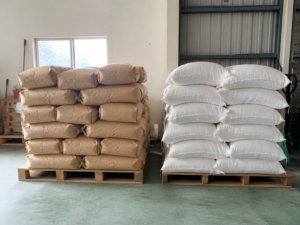
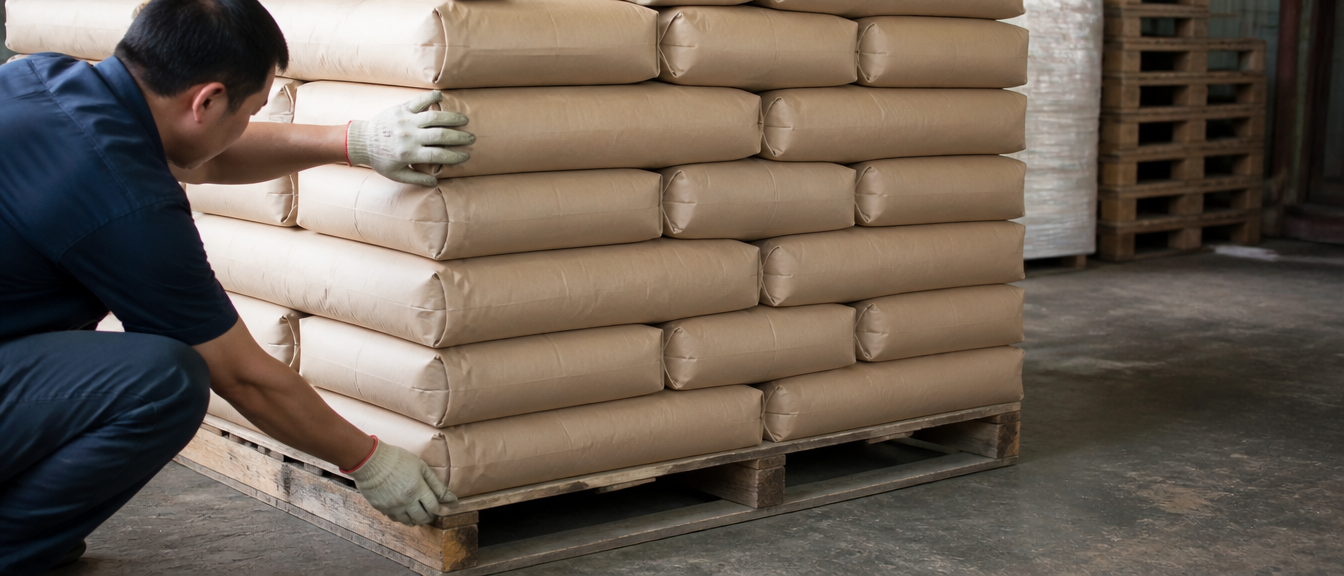
The "Sack Handling Recommendations" Part 1 (for filling plants, June 2017), jointly produced by EUROSAC and CEPI Eurokraft, lists improper bag orientation as a risk for unstable or even tilting pallets. The recommended practice is interlocked sack stacking, with bag edges flush with the pallet edges and no overhang (see EUROSAC Sack Handling Recommendations Part 1).
The Hong Kong Occupational Safety and Health Council's Cargo Storage and Transportation Industry Safety and Health Newsletter Issue 29, "Safe Stacking of Goods" (March 2002), classifies the arrangement of goods on pallets into four types: block, cross, pinwheel, and brick patterns. This document uses the term "pallet" (卡板), referring to what we call a pallet; for bagged goods, it also states that a good stack must be interlocked (this section discusses ground-level stacking) (see Hong Kong OSH Council's "Safe Stacking of Goods").
The terminology in the two documents doesn't fully align: EUROSAC uses "interlocked," while the Hong Kong document uses "interlocked combination," and also names a specific pattern called "cross arrangement." This article uses "interlocked stacking" as a general term, referring to the practice of offsetting the direction or position of bags in adjacent layers so upper and lower layers interlock with each other. As for whether a specific pattern equals "interlocked," neither document provides a direct comparison, so the table below simply reproduces the Hong Kong document's description of the four patterns.
| Arrangement pattern | How each layer is arranged | Guidelines from Hong Kong documentation |
|---|---|---|
| Block stacking | All items face the same direction, with each layer using the same arrangement | Usually prone to collapse; strapping must be used to secure it |
| Cross stacking | On a square pallet, items in the same layer face one direction, with each successive layer rotated 90 degrees | If items are not square, they are less prone to collapse. The advantage is easy placement and secure strapping |
| Windmill pattern | Items are arranged in an alternating crisscross pattern resembling a windmill, with the next layer oriented in the opposite direction | Suitable for stacking non-square items on a square pallet |
| Brick pattern | Items are arranged in a grid combination, with each layer having the same shape but rotated 180 degrees | The document provides no additional commentary |
For paper bags, this table offers two reminders. First, block arrangement repeats the same pattern on every layer, and the document explicitly states it's prone to collapse, so it cannot rely on the bags alone for support. Second, EUROSAC doesn't specify which pattern paper bags should use—it only requires interlocking with edges flush. Whether to use cross, pinwheel, or brick patterns in practice depends on whether the bag dimensions can fully fill the pallet, which requires the bag supplier and filling line to jointly verify dimensions—not something a single article can decide for you.
Bag edges must align with the pallet: overhang, looseness, and the pallet itself
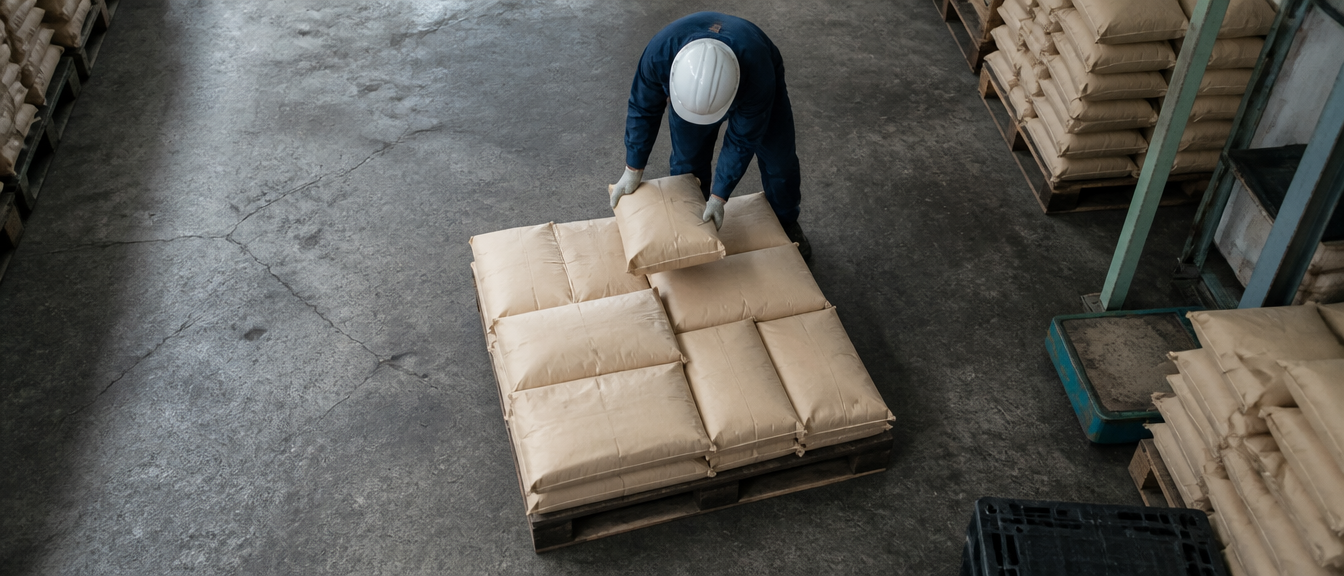
EUROSAC's guidelines organize pallet issues into three columns: risk, consequence, and solution. Regarding bags overhanging the pallet edge, the stated consequences are pallet instability during transport and handling, bag tearing, and bag rupture; the solution is to use appropriately sized pallets to avoid overhang, using standard 1,200 × 800 mm pallets where feasible (EUROSAC's recommendation—please confirm actual dimensions yourself). If overhang is unavoidable, it should not exceed 2.5 cm.
One cause of bag overhang is underfilling. The original document notes that underfilled bags sag and extend beyond the pallet edge, potentially tilting the entire pallet. Three recommended solutions are: using smaller bags, improving the filling machine's deaeration, and improving the palletizer's bag compaction.
This is where the bag side can help. EUROSAC addresses improved deaeration from the filling machine's side, while Chia Huang's micro-perforation venting assists from the bag's side: tiny perforations designed into the bag body allow trapped air to escape immediately during high-speed filling. Our functional processing page also lists "no residual air in the bag, more stable stacking" as a benefit of this process. The two aren't in conflict, but whether venting is sufficient still depends on the filling machine type and the fineness of the contents—please specify this when requesting a quote.
The pallet itself also affects the outcome. The original document recommends using close-boarded pallets with narrow gaps between boards, to prevent bags from sagging between slats and being damaged by forklift tines. If pallets are expected to be stacked on top of each other later, consider block pallets with cross-wise bearers. If a pallet's boards are cracked or nails are exposed, lay a protective sheet on the pallet before placing bags.
How many layers and how high: why three documents show different numbers
Let's clarify a point that's easy to confuse: the "layers" in this section refer to the number of layers of bags stacked on a pallet, unrelated to the paper bag's own structure of 1 to 5 kraft paper plies—and film lamination is a separate single-layer coating process applied to the base material's surface. These three are different things.
There's no universal number for stacking height. The table below places the scope covered by each of the three documents side by side, so you can determine which figure applies to your situation.
| Source | Applies to | Principles or figures in the document | Important notes when reading |
|---|---|---|---|
| EUROSAC and CEPI Eurokraft, 2017 | Pallet operations at paper bag filling facilities | Interlocked stacking; bag edges flush with pallet; maximum overhang of 2.5 cm; use 1,200 × 800 mm pallets where feasible | No specific stacking height provided |
| Occupational Safety and Health Council of Hong Kong, 2002 | General cargo; bagged goods are one category | Pallet load height generally should not exceed the pallet's longest side; pallets stacked on top of each other typically should not exceed 4 load-heights, with 6 as the absolute maximum | Wrapping with stretch film or strapping can stabilize the pallet and allow height to exceed the guideline; not a paper bag-specific document |
| Indian Standards Institution IS 4082:1996 | Storage of cement bags at construction sites | Stack height not exceeding 10 bags; width not exceeding 4 bag-lengths or 3 meters; when stacking exceeds 8 bags, alternate lengthwise and crosswise arrangement | Addresses on-site stacking rather than pallet operations; the upper limit is intended to prevent cement from compacting under pressure |
The figures in the three documents don't contradict each other—they simply cover different subjects. The 10-bag limit in IS 4082 (1996 edition, reaffirmed 2003) is meant to prevent cement from caking under pressure (see Bureau of Indian Standards IS 4082:1996); it also notes that bags in the bottom layer may develop a "warehouse pack" due to pressure, which can usually be loosened by rolling the bag when retrieving it, while already-caked bags should be set aside. The same Hong Kong newsletter, regarding bagged bulk materials (examples include rice, fertilizer, plastic pellets and concrete), states that odd and even tiers should be stacked alternately, with every six to eight tiers replacing an even tier with a "bonding tier," and recommends marking boundary lines on the ground to leave space for the bottom-layer bags to flatten out—this method allows stacking up to 30 tiers maximum. Even though both deal with bags, the two documents address different concerns, and their limits cannot be directly compared.
The preamble of IS 4082 also notes that specially manufactured products should be stacked and stored according to the manufacturer's instructions. Our view, therefore, is this: stacking height should be determined jointly by whether the contents will cake under pressure, the paper layer and coating design of the bag, whether pallets will be stacked on top of pallets, and what wrapping or strapping measures are used — not by applying a single fixed number. If you need a stacking height specified, please let us know your storage and transport conditions as well.
What anti-slip agents can and cannot do
Chia Huang's approach is to apply an anti-slip agent to the bag surface, increasing friction between bags, with the goal of preventing pallet stacks from sliding or collapsing during handling or transport once stacked high. Anti-slip agents can be combined with micro-perforation venting and moisture resistance on the same bag—cement bags often require both moisture resistance and anti-slip properties simultaneously. The principles behind each process are summarized on our Functional Processing page. Anti-slip agents are one effective way to reduce collapse risk, and work even better when combined with correct stacking methods.
Anti-slip agents aren't the only solution. For the risk of "bags sliding against each other on the pallet," EUROSAC lists several ways to stabilize pallets: using bags with anti-slip treatment, placing anti-slip-coated interleaving paper between layers, applying adhesive dots or tape during stacking, spraying water during stacking, and wrapping the outside of the pallet with stretch film. The key point of this list is that these methods can be used together, and most occur during palletizing operations at the filling plant, not just on the bags themselves.
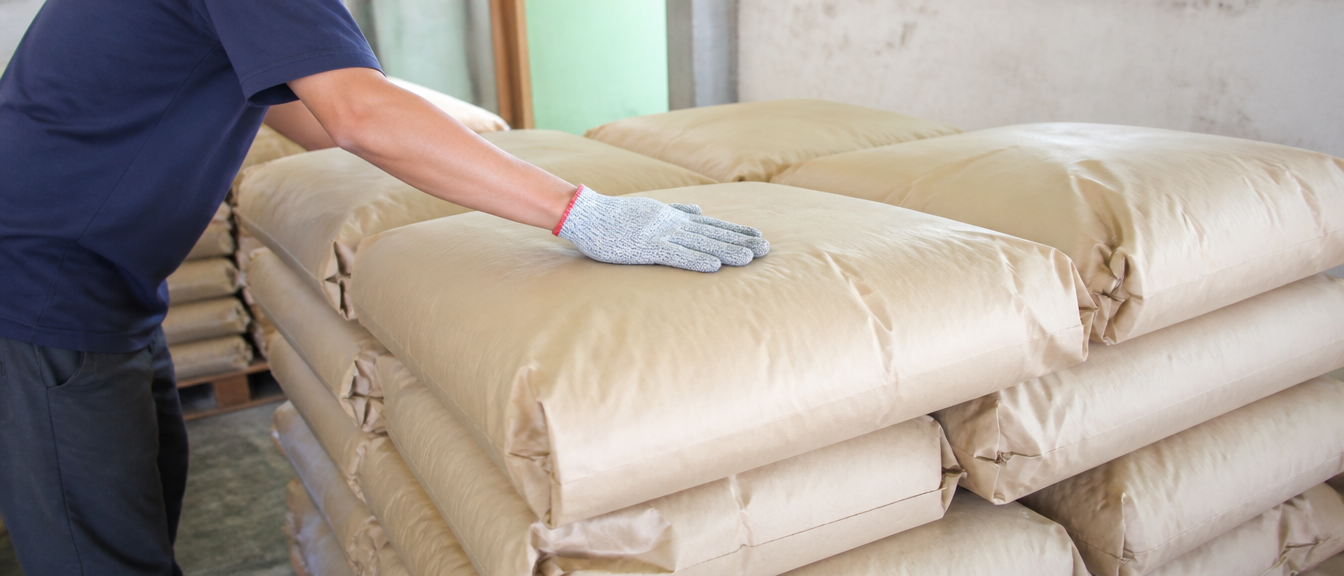
There are a few more related reminders for stacking. EUROSAC notes, in the section on pallet loading and unloading, that if the bag surface is tacky, loading or unloading the top pallet may snag on the top bag surface of the pallet below, causing tears—it's recommended to lay a protective sheet on top of the lower pallet first. Conversely, when the pallet's top surface is too slippery, stacking pallets becomes unstable, so it's recommended to place a slip sheet on top of the pallet before stacking another one on top. Additionally, if a pallet is already tilted, don't stack another pallet on top of it.
| Measures to stabilize the pallet | When it occurs in the process | Trade-offs and reminders |
|---|---|---|
| Bags with anti-slip treatment | At the bag manufacturing stage | Jia Huang treats bag surfaces with anti-slip agent; must still be combined with cross stacking and bag edge alignment |
| Interlayer sheets containing anti-slip agent | Placed between layers during stacking | Requires an additional material and placement step |
| Point gluing or tape adhesive | During stacking | Part of filling facility operations; confirm the type and location of adhesive with your bag supplier beforehand |
| Spraying water during stacking | During stacking | EUROSAC notes this can also improve stability; however, paper bags absorb moisture—evaluate whether this conflicts with moisture protection requirements |
| Wrapping film around the pallet perimeter | After the pallet is formed | Hong Kong documentation also notes that wrapping with stretch film or strapping makes pallets more secure; this increases packaging materials and labor |
From a manufacturing perspective, our view is that anti-slip agents are responsible for increasing friction between bags, but they can't compensate for a deformed pallet shape, overhanging bags, or excessive stacking height. It makes more sense to first get interlocked stacking and bag-edge alignment right, then reinforce with anti-slip agents.
Prepare this information before requesting a quote
If you'd like to discuss pallet stacking and bag design with us, we recommend preparing the following information first: pallet dimensions (whether 1,200 × 800 mm), bag dimensions and weight per bag (common specs like 25 kg or 40 kg), bags per layer and planned number of layers, whether pallets will be stacked on top of each other, storage and transport environment (indoor, outdoor, or ocean freight), handling methods and stretch film usage, and any current issues you're experiencing, such as edge overhang, pallet tilting, or sliding during handling. With this information, we can determine whether anti-slip agents and micro-perforation venting are needed, or whether bag dimensions should be adjusted first. For complete specifications and customization options for cement and building material packaging, see Cement & Building Material Packaging.
Frequently asked questions about pallet stacking methods
What are the different pallet stacking methods?
According to the Hong Kong Occupational Safety and Health Council's newsletter, goods on pallets can be arranged in four patterns: block, cross, pinwheel, and brick. Block arrangement is prone to collapse and must be secured with straps. For paper bags, EUROSAC recommends interlocked stacking, with bag edges flush with the pallet edges.
Can paper bags stacked on a pallet overhang the pallet edge?
It's best to avoid this whenever possible. EUROSAC notes that overhang can cause pallet instability, bag tearing, and bag rupture, and recommends using appropriately sized pallets. If overhang is unavoidable, it should not exceed 2.5 cm.
What is the maximum number of layers for paper bags on a pallet?
There's no single answer—it depends on the contents and the stacking scenario. For example, IS 4082 recommends a maximum stack height of 10 bags for cement bags at construction sites, to prevent the cement from caking under pressure; the Hong Kong document states that pallets stacked on top of each other typically should not exceed 4 load-heights (counting whole pallet loads, not bag layers). When requesting a quote, please specify the contents, weight per bag, and storage/transport conditions, and we'll evaluate together.
Can Anti-Slip Agents Really Prevent Pallet Collapse?
Anti-slip agents reduce the likelihood of bags sliding against each other by increasing surface friction, making them one effective way to reduce collapse risk—but they can't replace correct stacking methods. Bag-edge alignment, interlocked stacking, and stretch film where needed should all be checked together.
How to Handle Pallet Tilting or Slippery Surfaces?
Per EUROSAC's recommendations, don't stack another pallet on top of one that's already tilted—stretch film can be used first to stabilize it. When a pallet's top surface is too slippery, place a slip sheet on top before stacking another pallet on it.
Conclusion: Pallet Stacking Methods Should Be Designed Together with Bag Design
Back to the original question: how should you choose a pallet stacking method? The answer isn't to find one standard pattern, but to check interlocked stacking, bag-edge alignment, stacking height, and anti-slip measures separately—then look back at whether the bag's dimensions, venting, and anti-slip agent can work together. If you're evaluating new paper bags, or already experiencing pallet tilting or bag sliding on-site, feel free to visit Contact Us and tell us your pallet dimensions, bag type, weight per bag, and stacking method. Chia Huang will respond with spec recommendations within one business day.